Kitchen Project: Sweet Potato Mille-Feuille

It’s official! Gnomerie Kitchen has a date for its first dinner. On November 21st I’ll be hosting four people for a six course test run of the Gnomerie Experience. I’ll be honest and say that there’s equal parts excitement and nervousness flowing through me right now but this is finally the chance to start finding my own way. My guests this first time out will get a tour of the flavors of autumn produce. My menu will run the gamut of some of fall’s favorite flavors combined with only enough extra ingredients as needed to elevate them for, I’m hoping, an excellent first service. While the finished menu is still up in the air I’ve settled on sweet potatoes, butternut squash, cabbage, carrots, corn and will close the meal with apples as a dessert.

In creating this first menu I remembered an idea I got from Chef Ken Miller, sweet potato Mille Feuille. The initial idea was to use a veg sheeter to produce squares of sweet potato that would be baked to crispness and then layered with a savory sweet potato filling. At the end of the day, however, this produced non uniform squares of varying doneness that wouldn’t work at all. Sweet potatoes contain a lot of moisture which inhibits many attempts to achieve success with applications that require them to be crispy. My next step, making a sweet potato Pâté Sucrée, produced a dough that needed so much flour to become workable that it tasted only of flour and had the texture of tree bark.
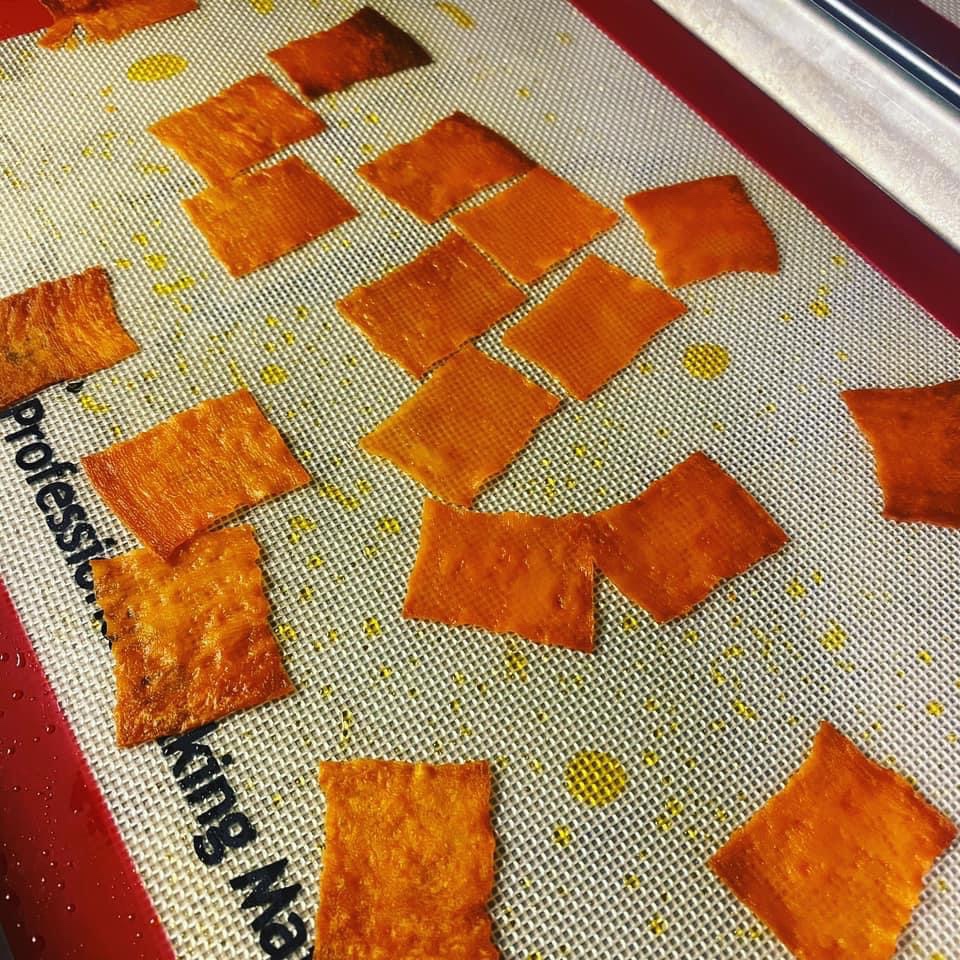
The first attempt at Mille Feuille layers. The idea was sound but because of the high water content in sweet potatoes these shrunk and deformed in the oven.

I decided to use sweet potato flour to assemble a puff pastry, since this is the traditional component for Mille Feuille. Puff pastry is a welcome challenge for any interested in cooking. The folds and turns along the way to lamination of the dough produces hundreds of layers of pastry interlaced with butter. As this butter hits the hot oven air the moisture evaporates and separates the layers of pastry. This creates a ridiculously tender, flaky and rich pastry. In my next installment, we’ll get a look at the finished and, hopefully, successful product. See you soon!
The rise of #GnomerieKitchen

From a young age I’ve loved cooking, I’ve loved being around the warmth of the kitchen with its countless sounds and aromas. I remember the kitchen in my grandparents home where I grew up and how it always seemed a gathering place for my family, even at non meal times. I remember the big, well seasoned cast iron my grandmother would toast bread in for stuffing, the pot my grandfather would make massive batches of meatballs and sauce in for Christmas Eve dinner, I remember the ever faithful KitchenAid mixer that would accompany my mother on the path to producing countless cookies, sweet rolls and cakes for all the holidays. I feel the warmth of everyone crammed around the table in the center of the kitchen for Sunday dinners. It’s pretty safe to say then, that the kitchen, for me, is a great source of memories. Thomas Keller, renowned chef/owner of the French Laundry, said that great cooking comes down to two things: nourishment and creating good memories, it is this ideal that inspired what has come to be known as Gnomerie Kitchen.

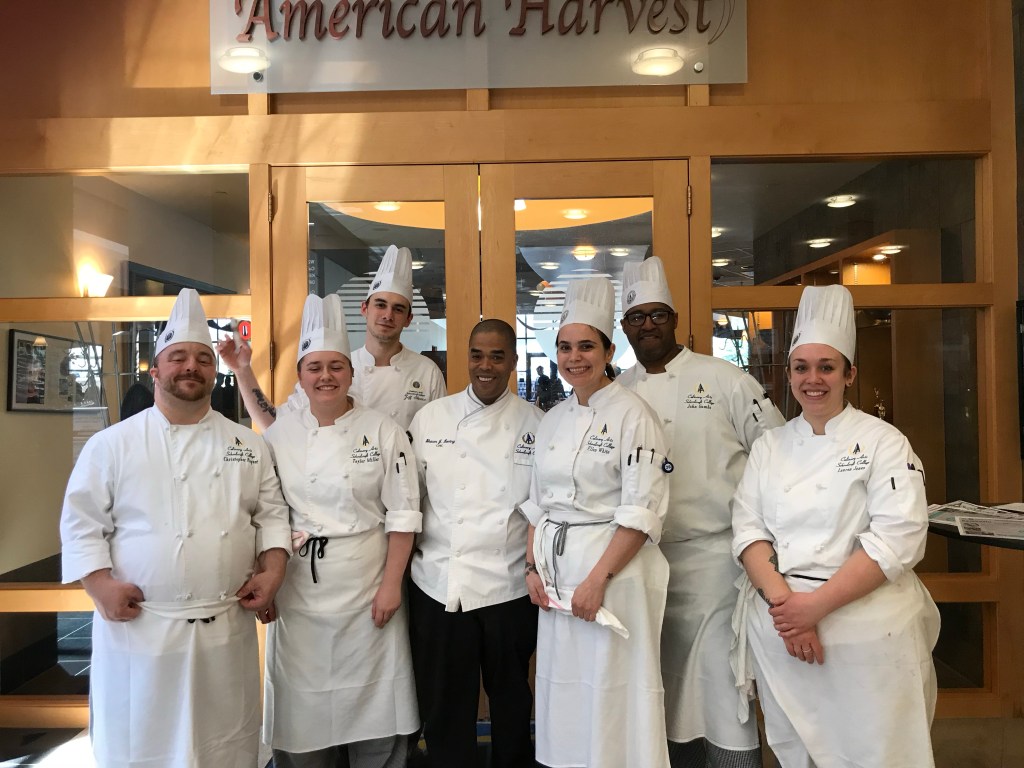
The beginning of my journey. Chef Shawn Loving was my first culinary mentor. I spent a year with him learning the beginnings of refinement, an unyielding desire to improve my craft and what it truly means to be a leader.

When I welcome people into Gnomerie Kitchen it will be an opportunity for me to tap into those same memories that I have. Maybe a strawberry dessert reminds them of the first time they picked strawberries, the sun just rising over the field, the slight chill in the air, their shoes getting muddy from the soil and the cold drops of water falling from their hand as they reach into a bush to pull out their first vibrant, red strawberry. What if it also reminded them of a trip to Paris years later with a special someone? Strolling down the streets that seem to have a patisserie on every corner. Wouldn’t it be something to connect that first time they held a fresh strawberry with the first time they tasted a Charlotte Fraise while watching the sun sink into the Seine and lastly come full circle with a ripe, gorgeous strawberry served in all its glory? Maybe that is the true spirit of Gnomerie Kitchen then, finding the right balance of the humble and the refined.

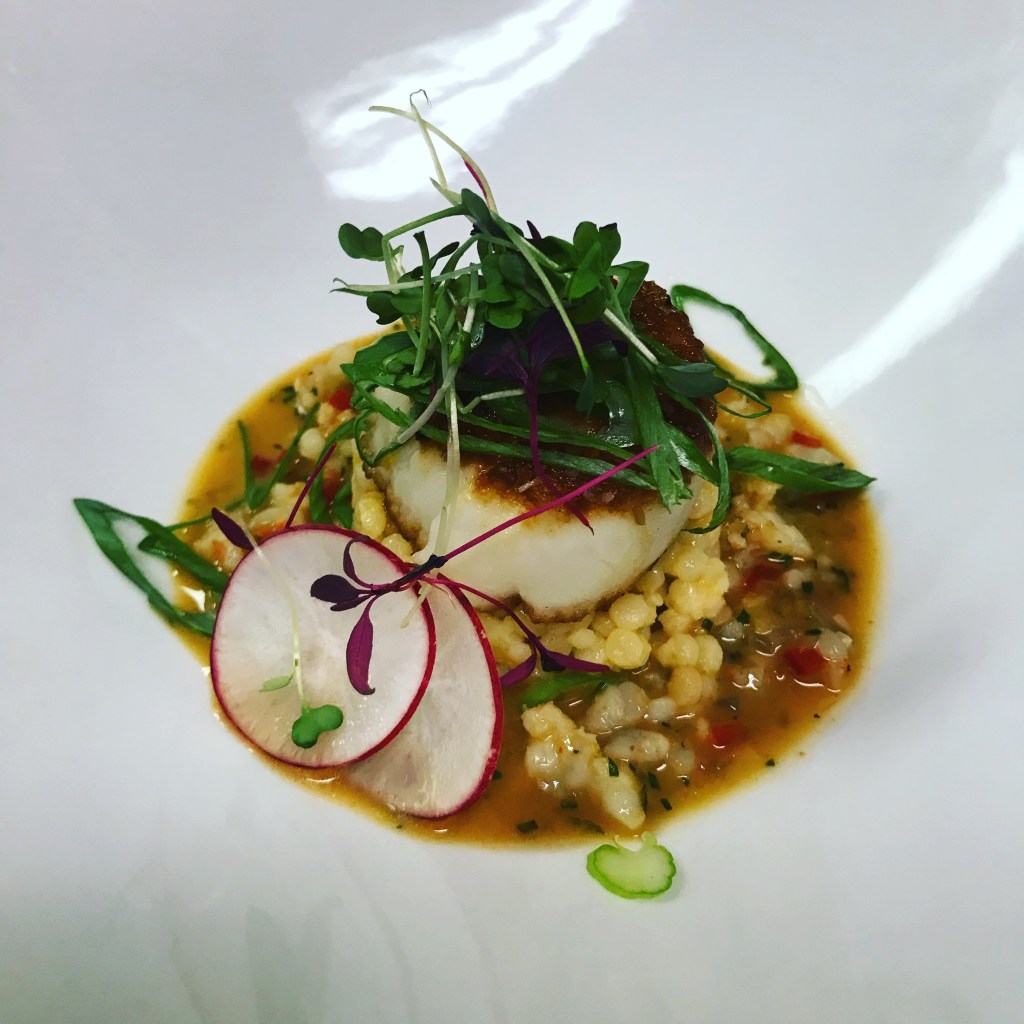
One of my favorite dishes so far. It started in cooking school with a menu project idea. Seared diver scallop | Pearl Couscous| Gulf Shrimp | Coconut Broth

In all fairness, I should probably clue everyone in to where the gnome in Gnomerie comes into all this. My girlfriend, Megan, has slowly accumulated quite a few gnome figures handmade by a local crafter named Julie Stuver. Each gnome is completely unique and they encompass every season and numerous genres. Anyway, I was stuck on a name for the project and soon connected gnomes and their roots in nature with the farm to table nature of my dishes and soon came up with Gnomerie…after initially going with Gnoma. Chef Ken Miller told me this might cause a copyright issue with the actual restaurant NOMA.

Concept art for the branding side of the things. I just wanted something fun for the logo and menus. I’m still up in the air about the flower.

Since I decided to follow this culinary path I have always felt that being a chef wasn’t what I really wanted. I just wanted something small to call my own, carve out my own little piece of this huge craft and fill it with whatever I wanted to make of it. Going through cooking school we were told that certification with the ACF is the way to go, putting in years and years of learning, making mistakes and pushing ourselves until we earn the title chef and lead our own kitchens. It’s taken me awhile to come to terms with that not being my measure of accomplishment. I’m seeking to recapture those familial moments of my childhood and share them with my guests, albeit with food slightly more elevated than my grandfather’s goulash, as tasty as it may have been. It won’t be just me, GnomerieKitchen will in time become a collective, different creative personalities finding an outlet for their visions in a more intimate setting than that allowed by the typical restaurant kitchen. So that’s it then: strangers perhaps finding new memories with each other, elevated dishes, finding the best each season has to offer and bringing it to the plate. There’s no true theme, there’s going to be stuff from all over the world and all flavor profiles. It’s about exploration and sharing that explorative journey with the guest. Like chef Keller said: nourishment and creating good memories, it’s my hope there will be plenty of both. Welcome to my kitchen.

The rise of #GnomerieGarden

Welcome back! Like I said in my previous post, with the warm June weather and plenty of water my garden began growing with surprising success. I say surprising because this was the first time I’d ever really tried to grow anything, especially at this scale. It was amazing to see the progress as the days and weeks went by and wonder what sort of overall success I was going to have.
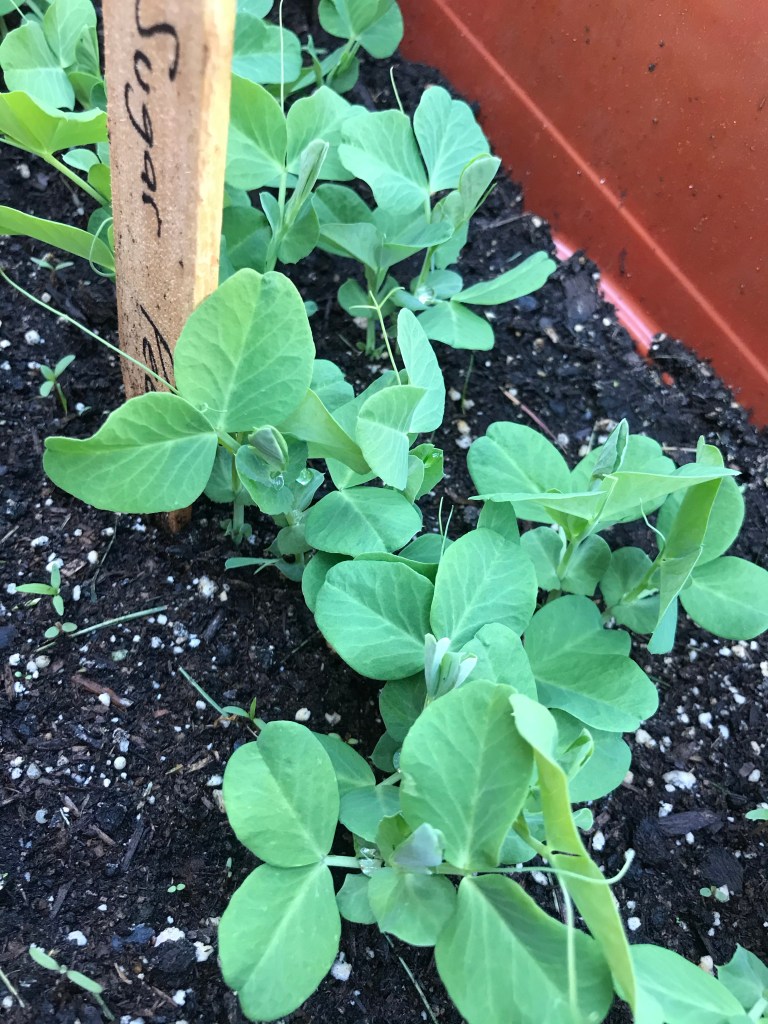
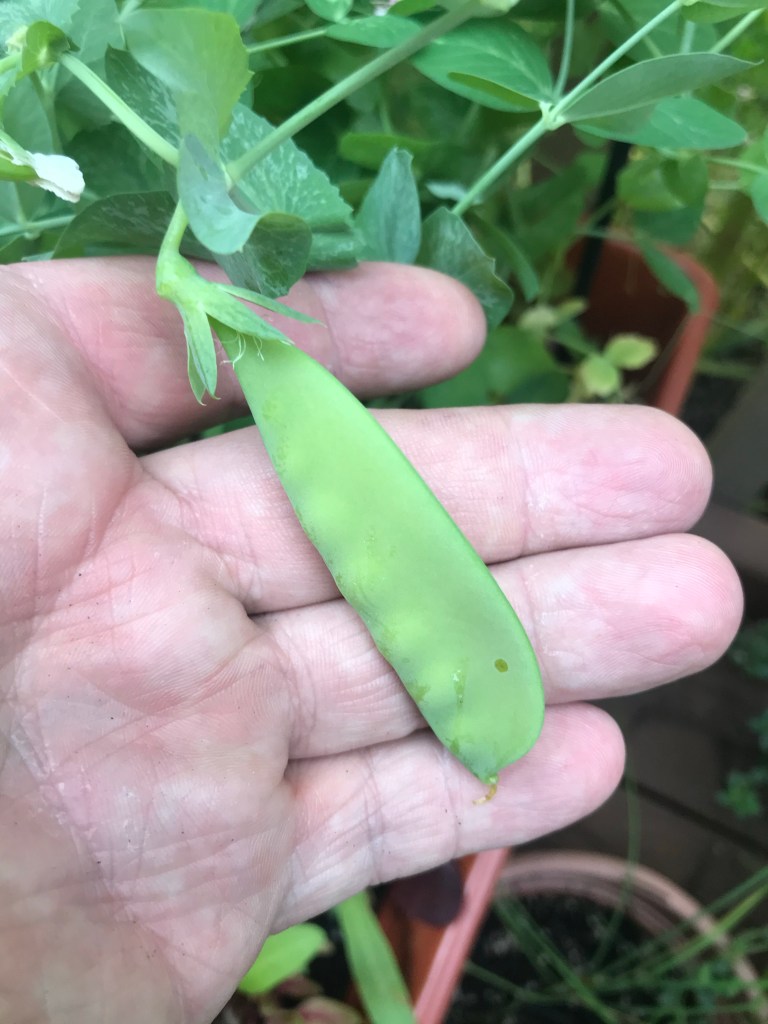
The steadily growing sugar snap peas, like I said before I lost both first plantings of peas but it was awesome to see the tendrils form.
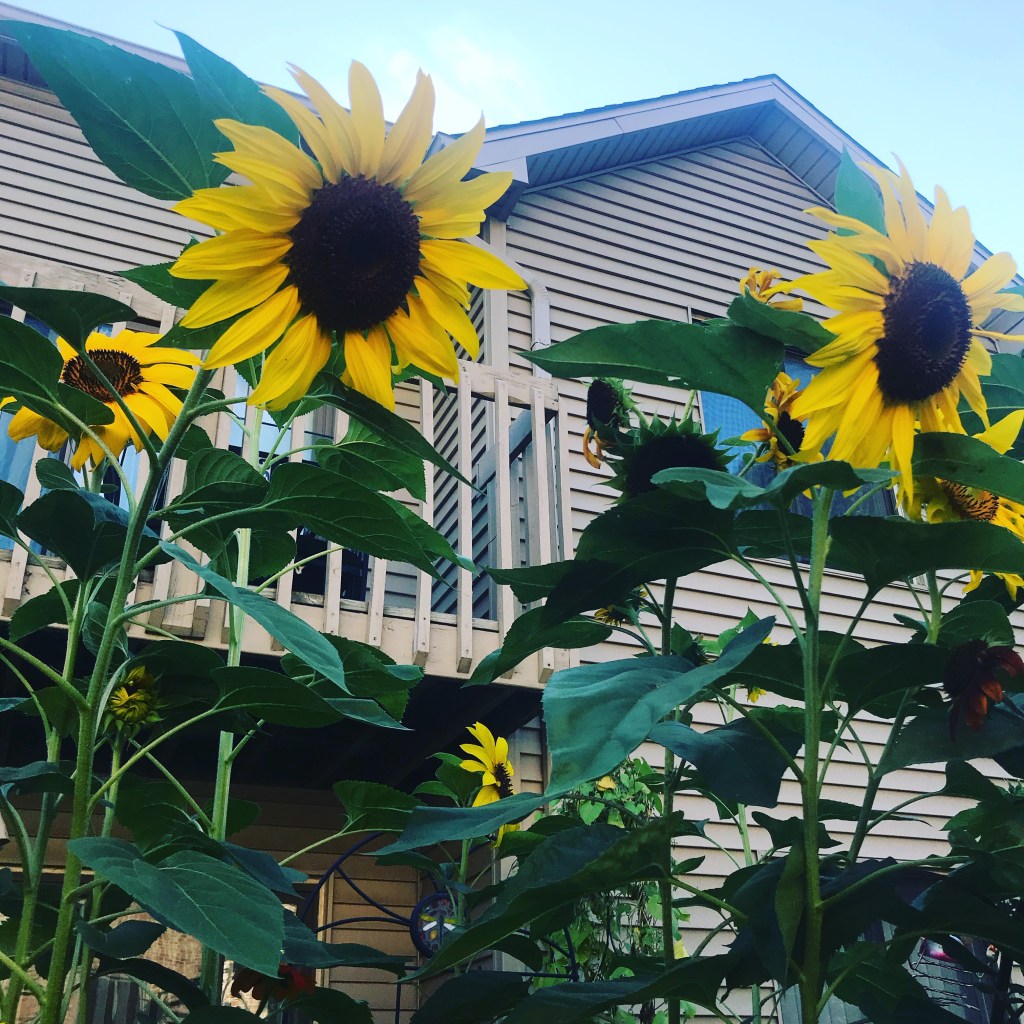
Just one of the mammoth sunflowers I planted about 3 weeks out. They grew exceptionally fast as the days went by and quickly began to fill out the space between our two coneflowers.

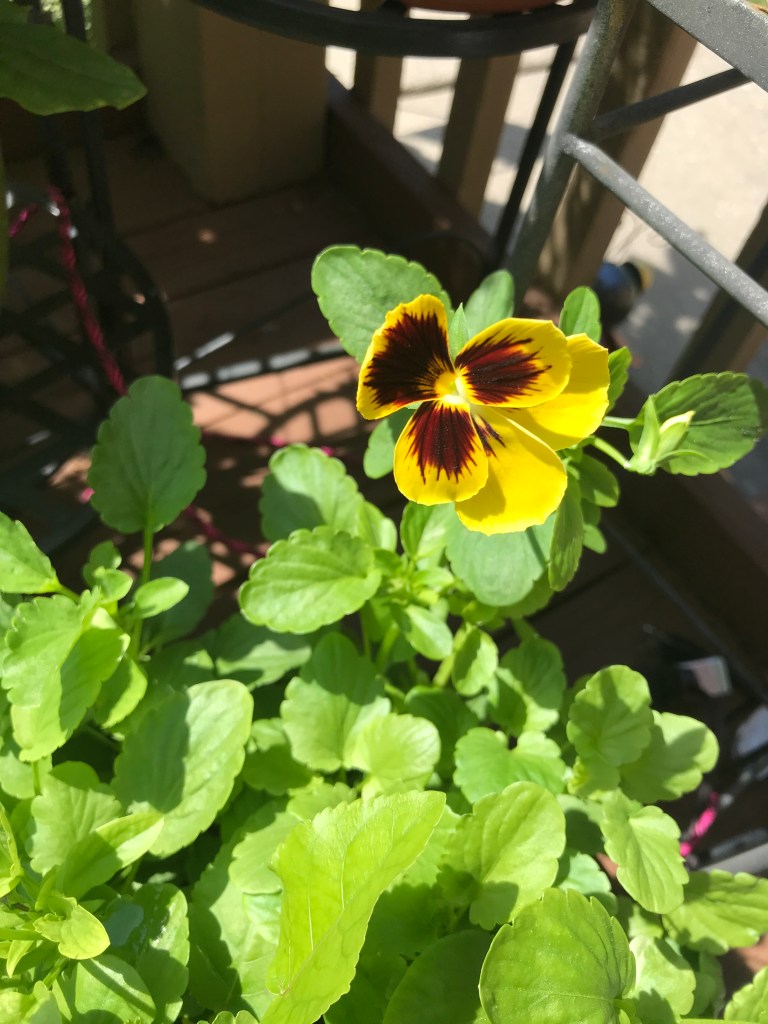
It seemed that the whole garden was growing every day, with a new addition I squeezed in once a week. We found a blackberry plant and three lilies at a farmers market, a pepper plant and a pot of salvia at Lowe’s and I planted a second pot of pansies to add some more color. As the different plants began to develop I noticed that there were small holes at the base of certain things like my chives, one of the tomato plants and in one of the large planter boxes. It would seem our garden had a visitor.

“Charlie”, the first of several chipmunks that I discovered were visiting the garden. It seems they enjoy digging into the root balls of plants for the nutrients. I thought at first if I left a dish of food for them every morning they would leave my plants alone. I ended up having to live trap them.

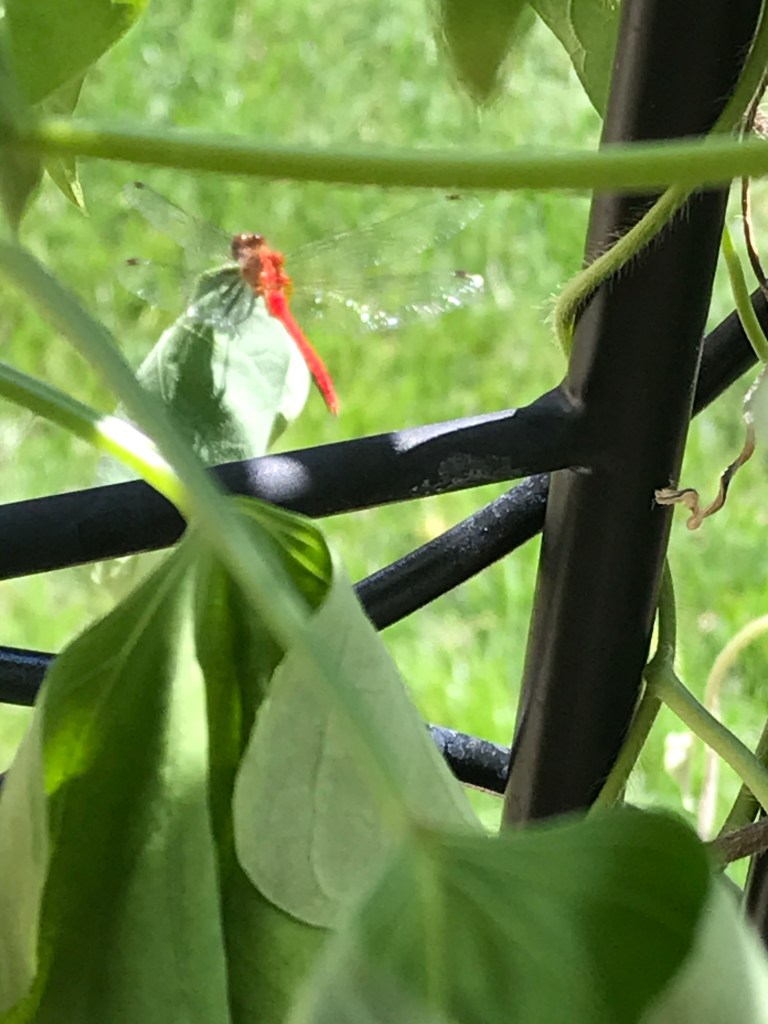
Whenever we start something as a beginner there is bound to be instances of setbacks or things that don’t turn out quite like we’d hope. This was definitely true with my garden, as I watched both types of peas, my beets and my eggplants either stop growing at a certain point or in the case of the peas the leaves turned yellow and the whole plant slowly died. As spots opened up I replaced what had been with something new, again with mixed results. Gone were the peas to be replaced in one box with a second planting and in the other box with cucumber plants, storm burst verbena, zinnia and anise hyssop. As the days went by the number of bumblebees and dragonflies multiplied and we received daily visits from rufous hummingbirds.

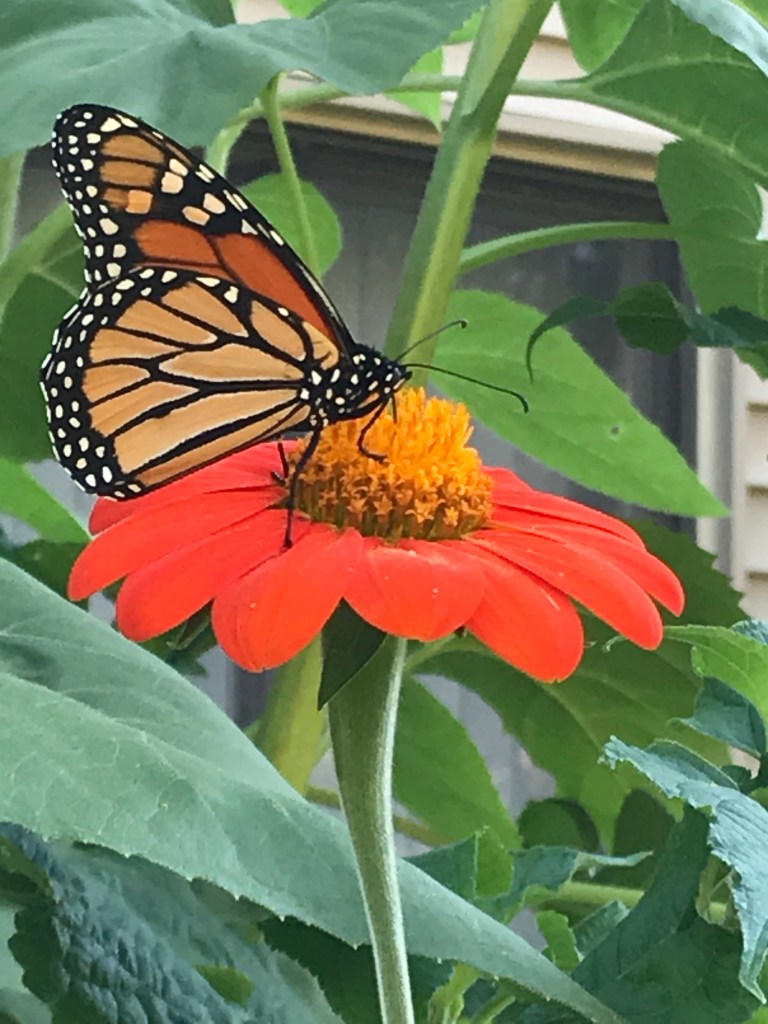
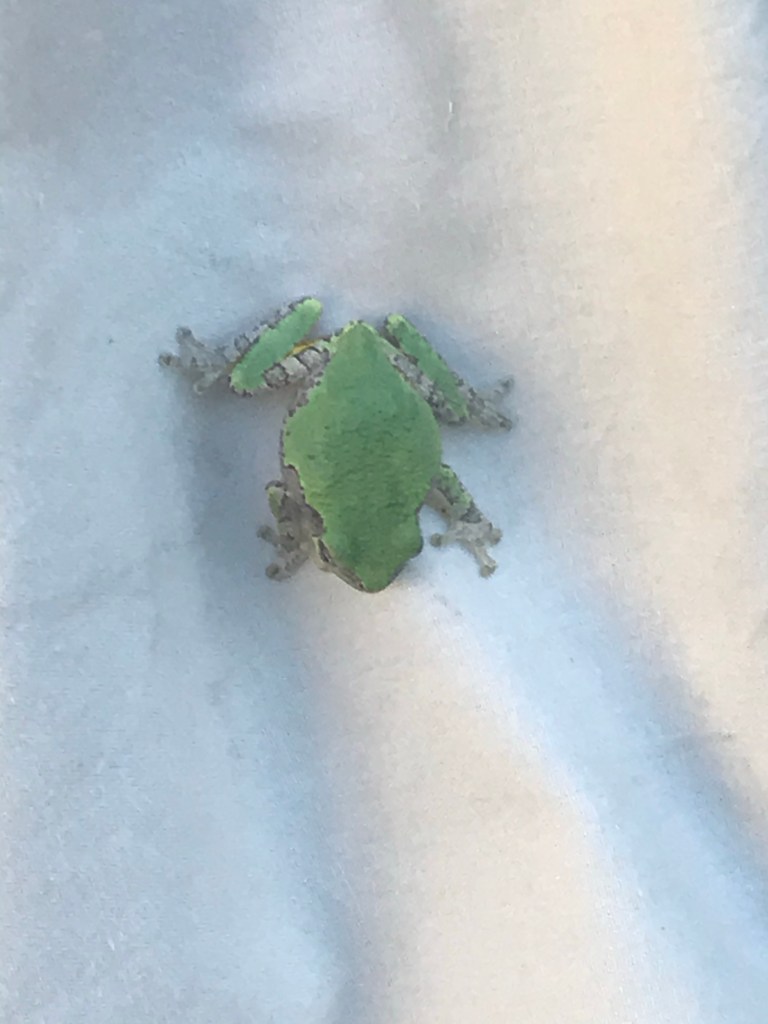
The rufous hummingbird that fed at our garden several times a day. He was joined by a multitude of bumblebees, dragonflies, butterflies and a tree frog. Gardens become just as much a sanctuary for nature as they do for us.

The days of July saw many of the plants growing toward maturity, the gerbera daisies now consistently had big, yellow blooms, the sungolds were coming in small, bright orange and yummy and the morning glories quickly overtook their trellis and formed buds. I also added marigolds and three horseradish plants in an attempt to discourage the chipmunks but while it may work for some they were very persistent.

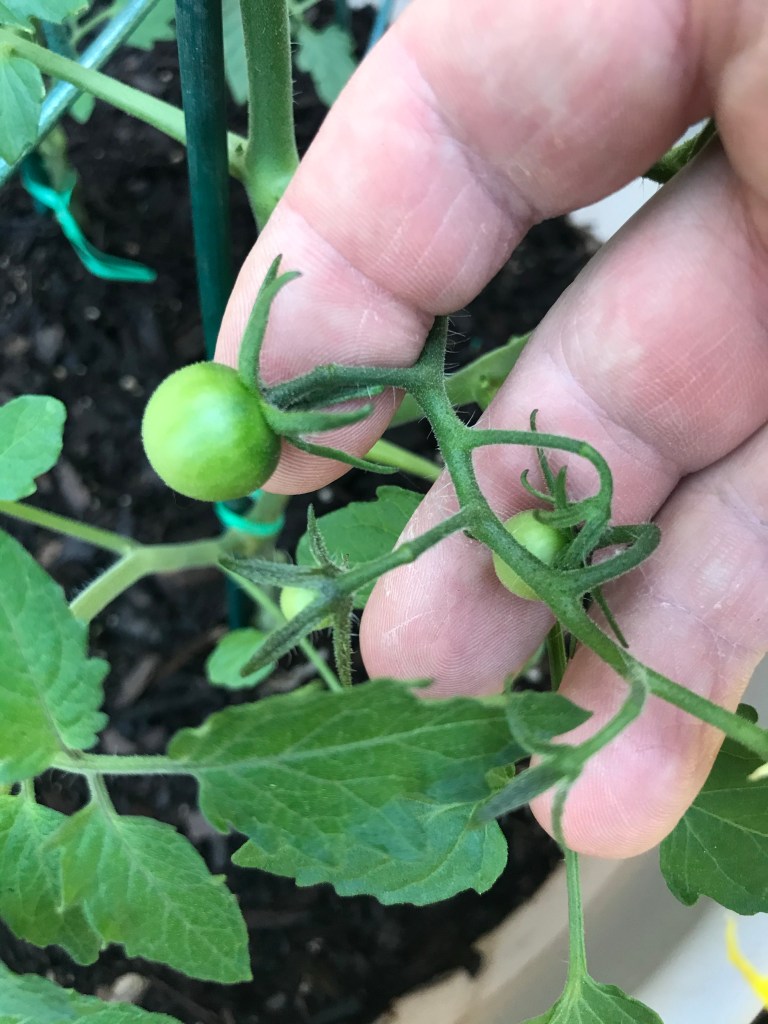
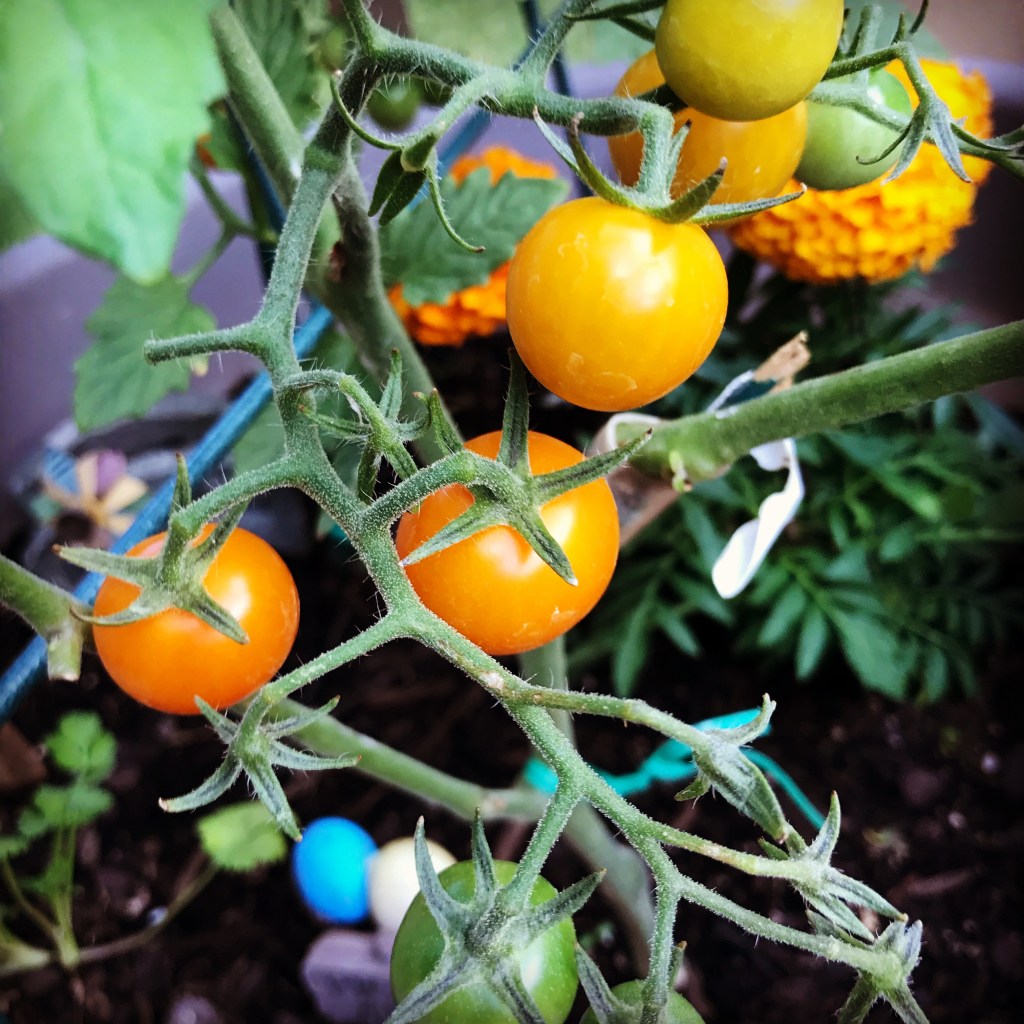
The first of the sungold tomatoes, careful pruning helped train them onto a trellis.
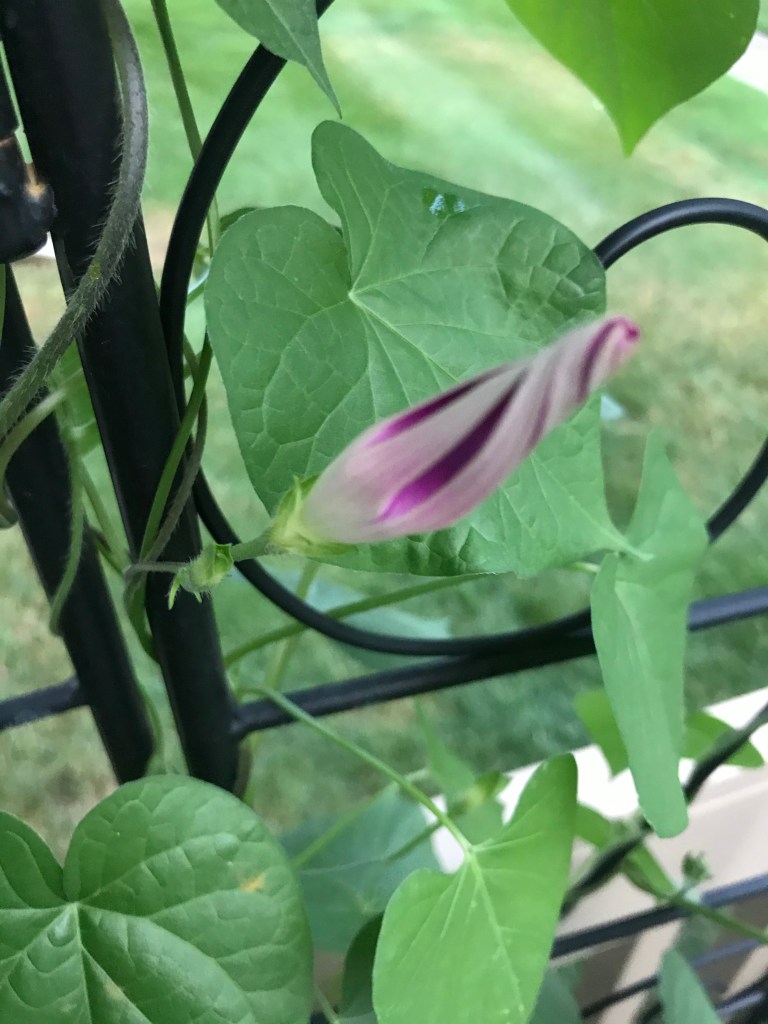
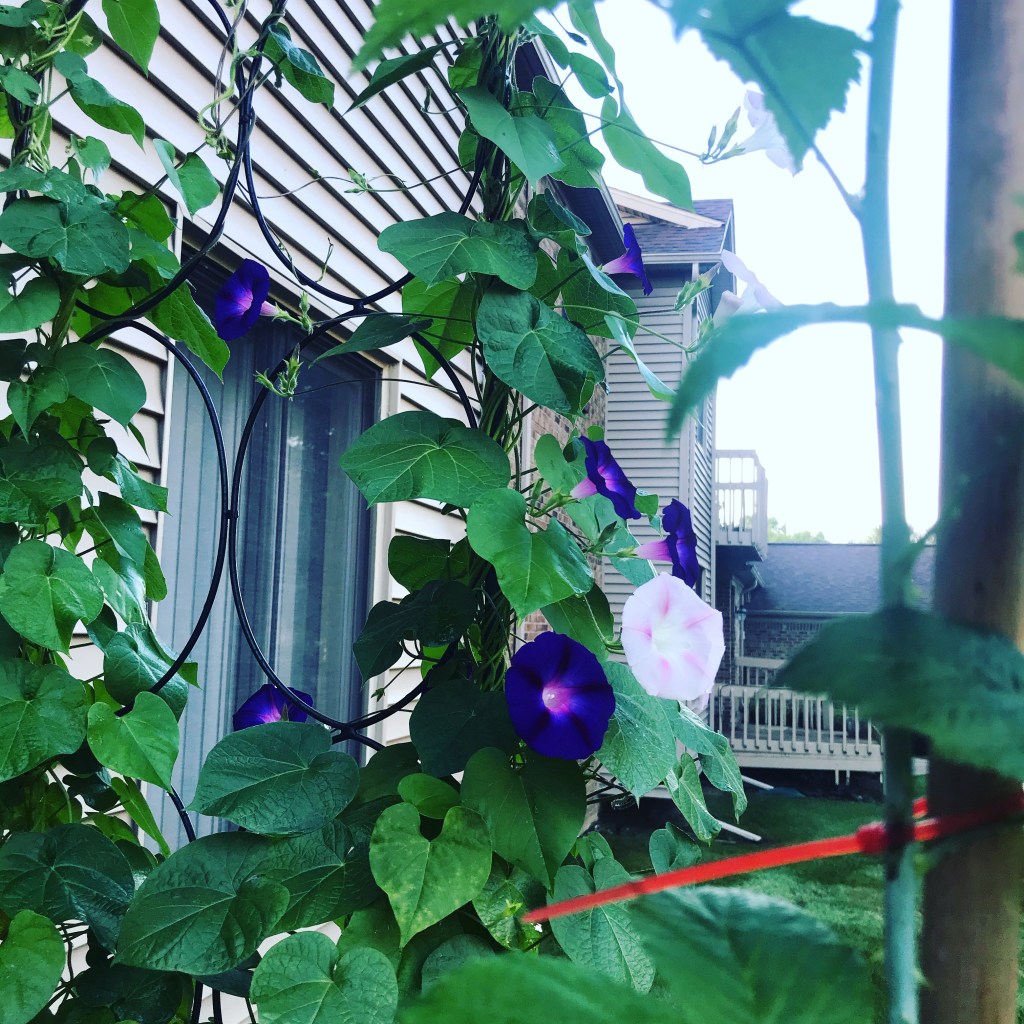
The first morning glory blossom. I learned that they open once then close and drop off, leaving a base that forms a seed pod.
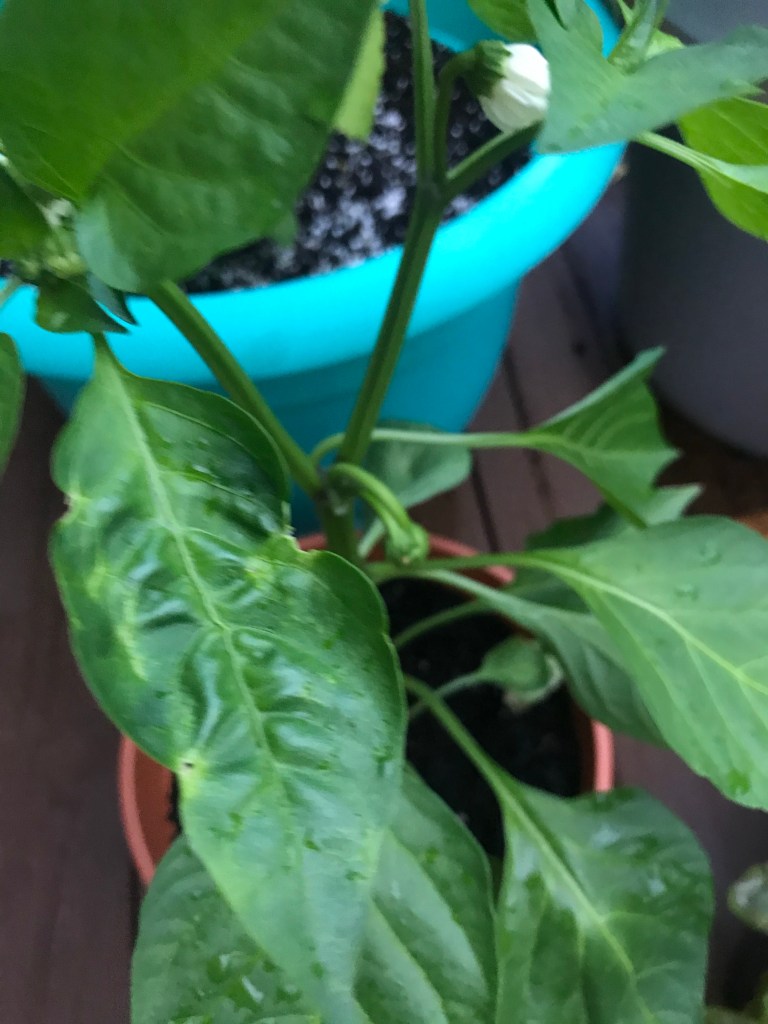
The beginning of a bell pepper, I ended up getting only on pepper from my plant.
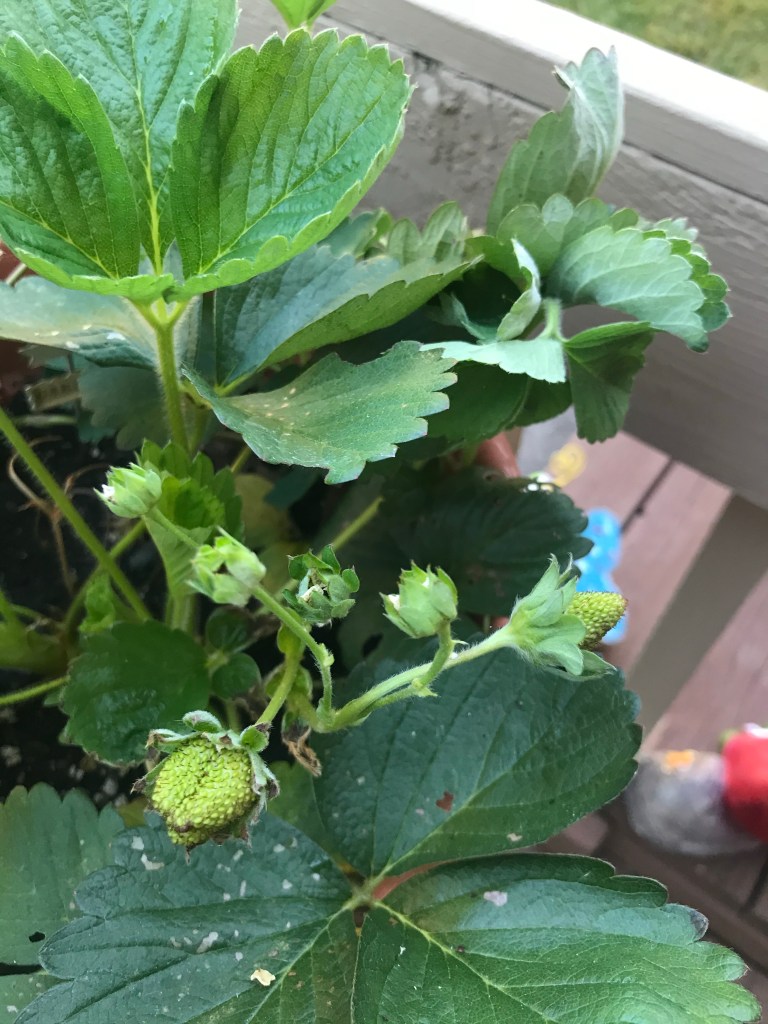
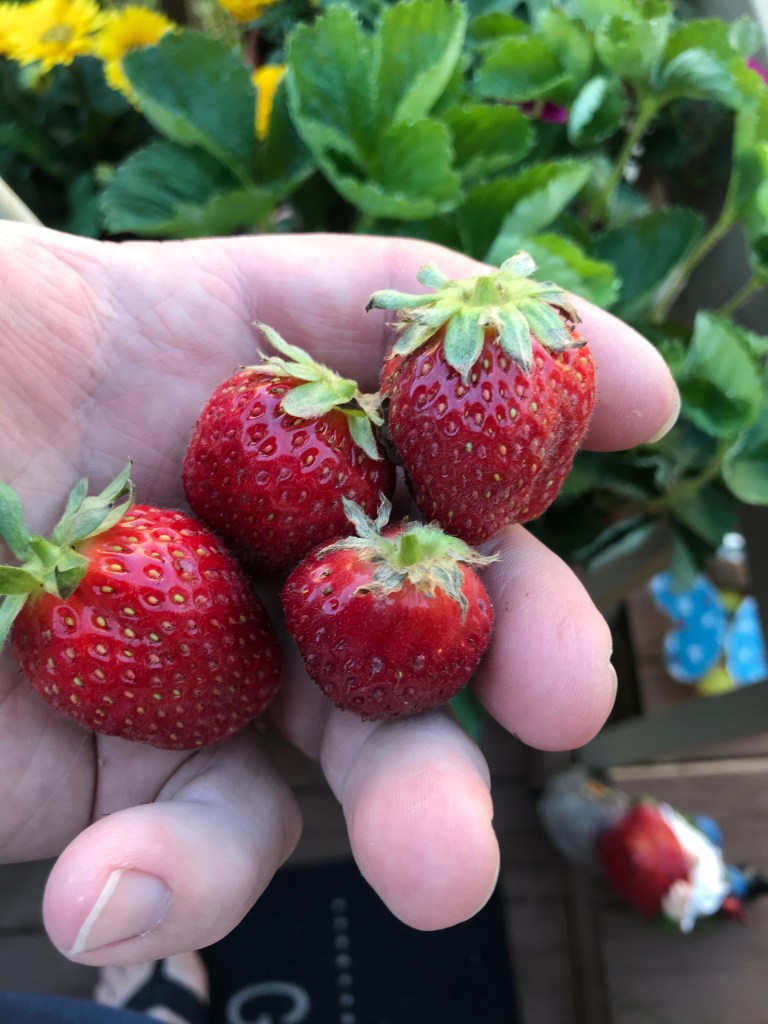
The strawberry plant gave us a few yummy strawberries but then became root bound so I had to move it into a bigger pot as the season ended.

The Sunflowers

Watching the sunflowers grow was a both satisfying and slightly humorous experience. It was almost like those experiments in grade school where you mix vinegar and baking soda and it overflows everywhere. When planting we intermixed several varieties such as Mammoth and Mexican Sunflowers. The stalks just grew and grew and then, just when we thought it wouldn’t happen, the heads formed.

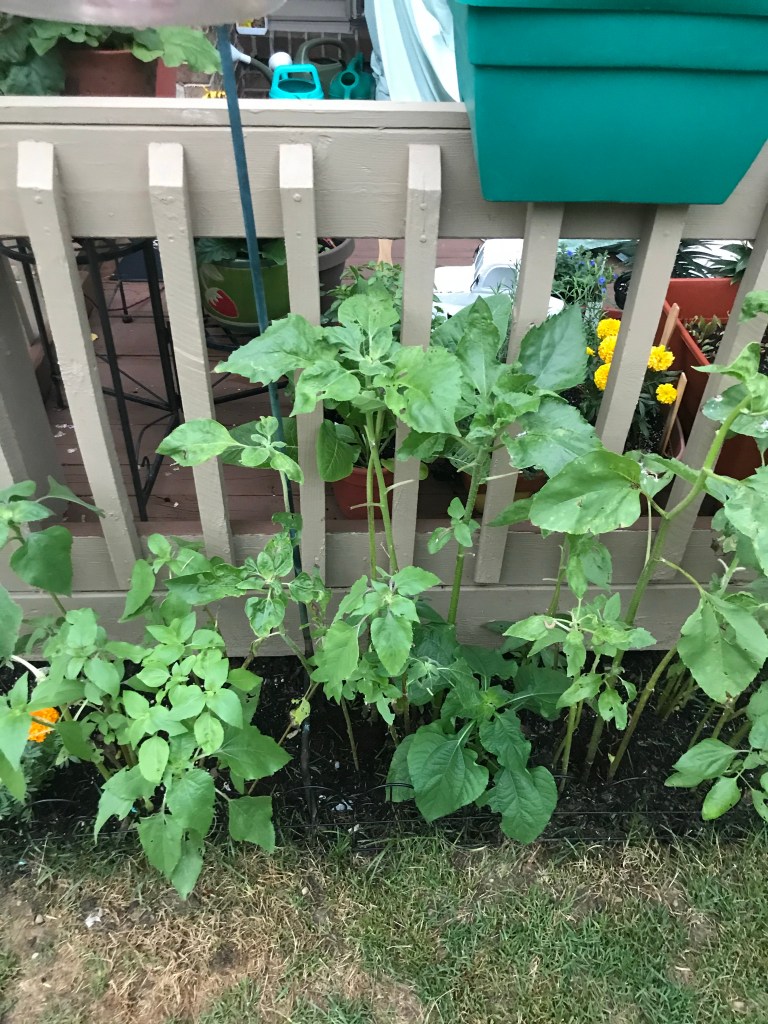
About a month and a half in, something had eaten a few over the course of the night but luckily they grew back.
Two months in, you can see on the left where the ones that had nibbled on were recovering.
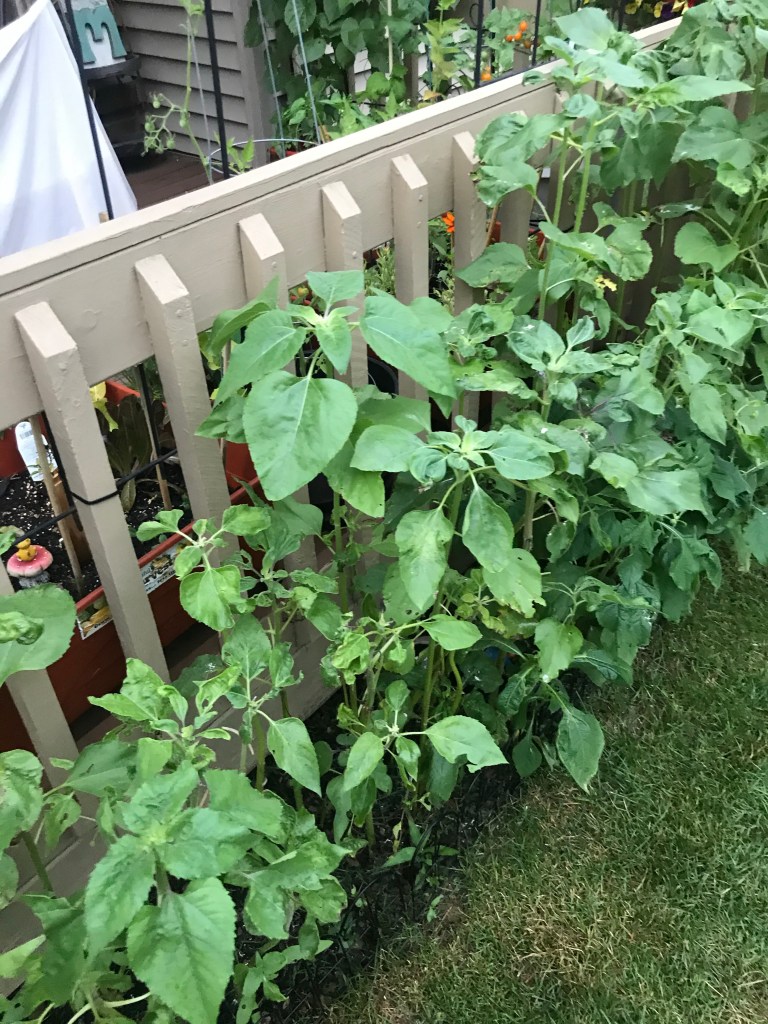
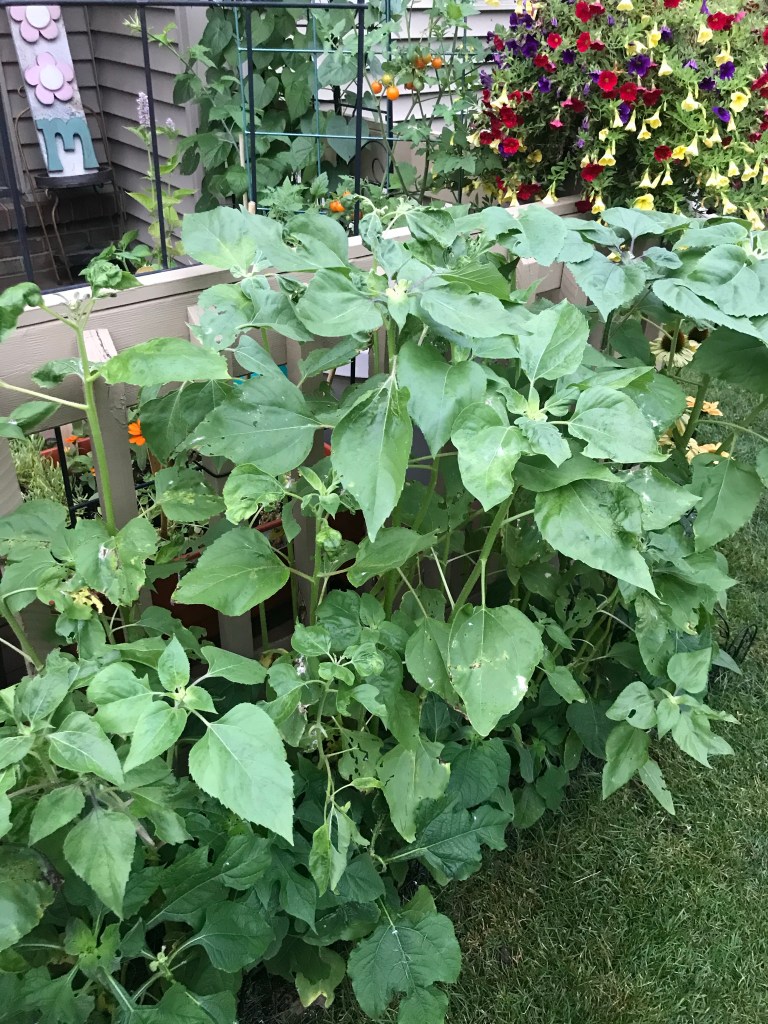
A little over two months in from planting
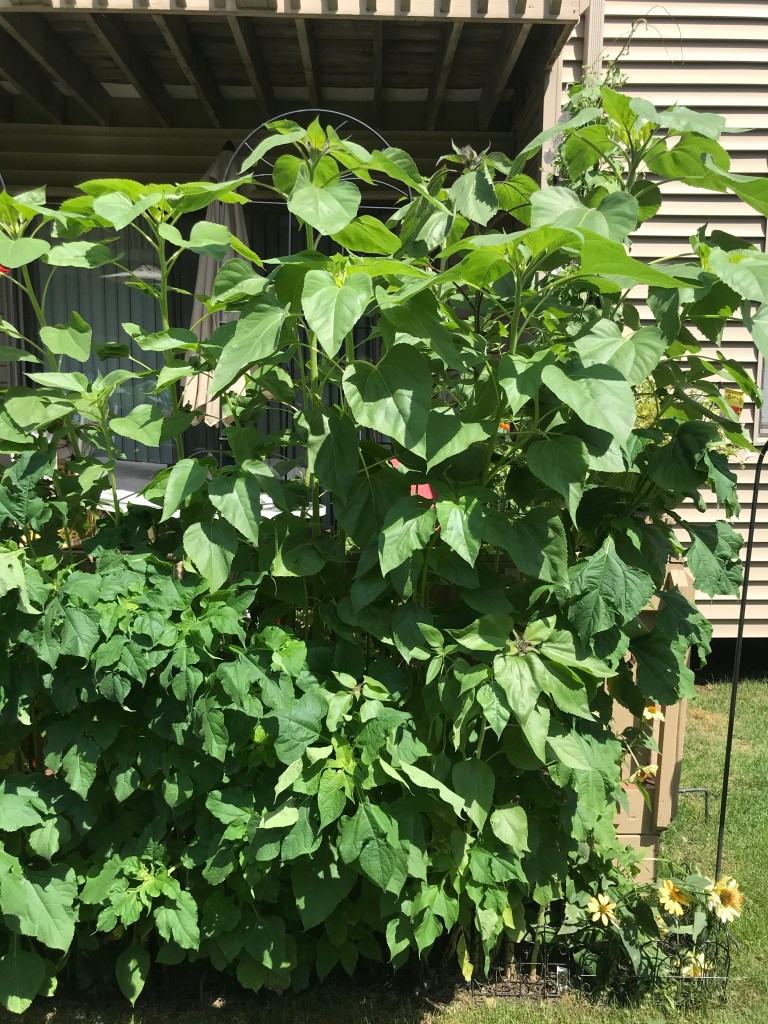
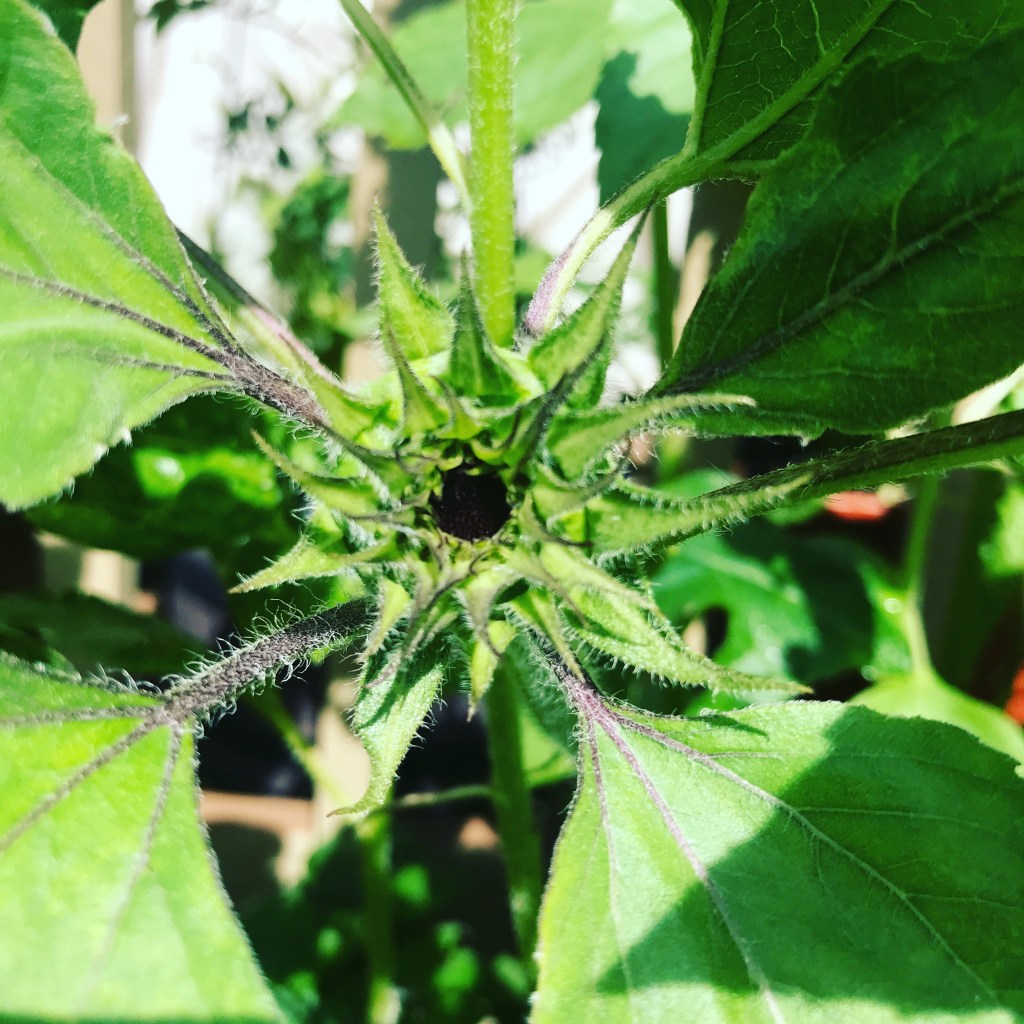
A little over two and a half months in, it wasn’t long after this that the first buds appeared. See the now dwarfed coneflower to the right?
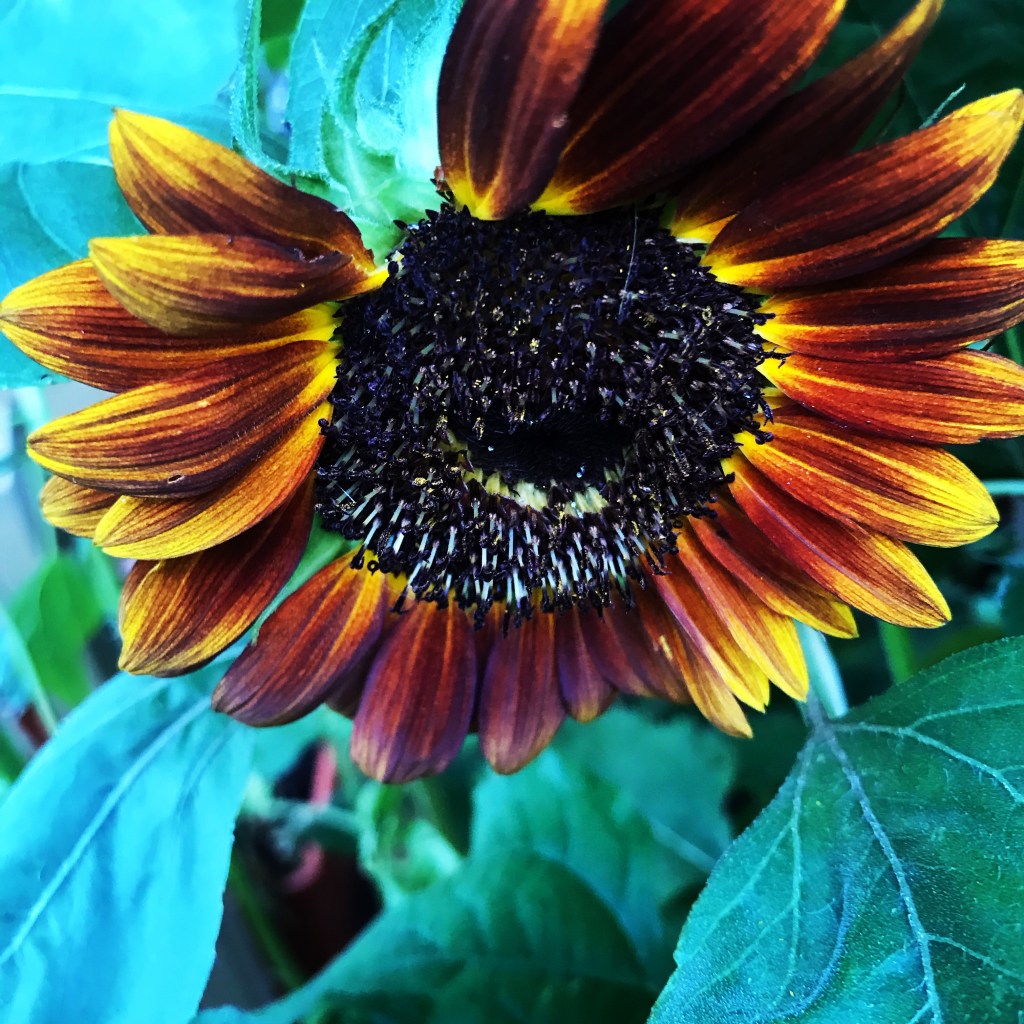
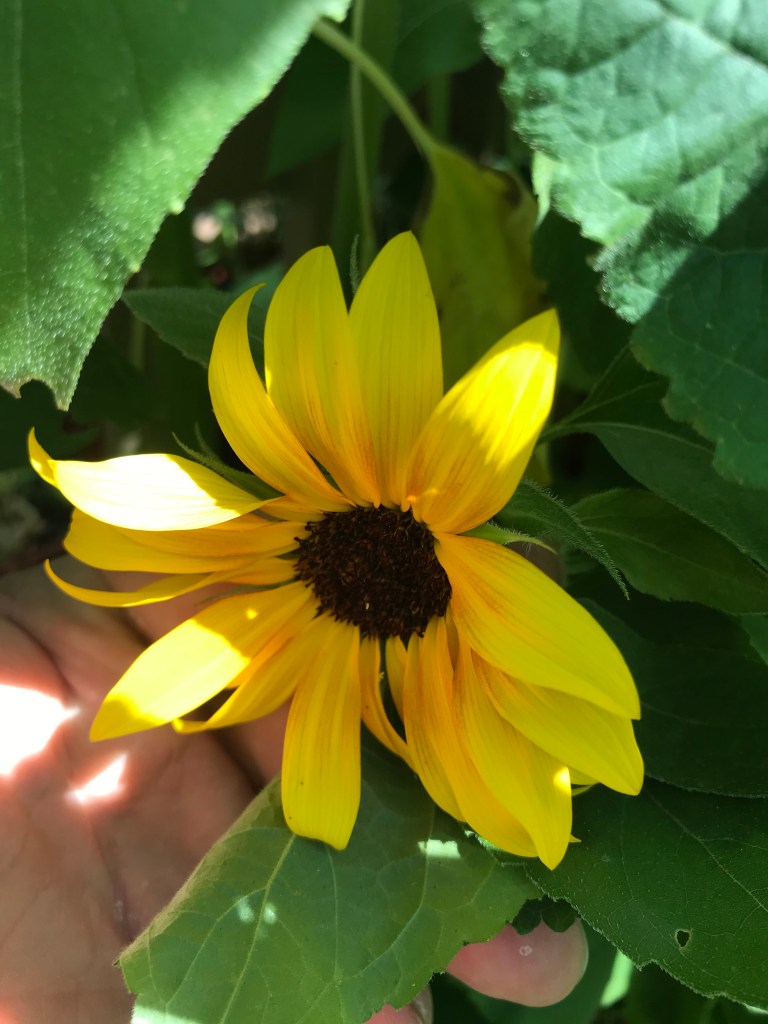
Finally! Once one appeared the buds popped up all over the place and it was only a matter of time til they began opening. It’s also a sad moment, because they signal the nearing of the end for the garden.

The entire garden seemed to peak at once so instead of a ton of words, I’ll show you.

On several occasions #GnomerieGarden became a B&B for bumbles.
#GnomerieGarden Security hedgehog Gus pops up on the camera system we installed to find out what was eating things at night early on. Never saw a single thing.

This was such an amazingly rewarding experience and I’m so excited to see what my gained knowledge helps me accomplish next year. The hours spent in the garden proved that what you put into something directly relates to what you get out of it. I’ve learned that dreaming is no substitute for hard work and the focus to accomplish what you’ve set your mind to. Talk soon

Long Time….no see

So it’s been awhile…and so much has happened since I last wrote. I think it’s been since before COVID hit us that I’ve published a blog post, my apologies to my loyal readership lol. Being out of work for almost 4 months was crazy as I’m sure some of you know. At my previous kitchen job, Toasted Oak, we closed after dinner service on March 14th and didn’t open again until July 1…sadly many restaurants won’t open again. Oh yeah, I’ve changed jobs since I last wrote as well, but more on that later. These last few months have challenged some of the feelings I’ve had as to what I thought were my long term goals and my perceptions of what I thought I should want for myself, more on that later too.

First off, the garden or as it’s come to be known on my Facebook and Instagram posts #GnomerieGarden. In my previous kitchen job, working under Chef Ken Miller, there was always an emphasis on how increasingly fragile our environment is becoming and how unless we take it upon ourselves to seek change the harm will become irreparable. Inspired by Chef Miller’s passion and connection to the land, I decided to tap into my farming roots and start a garden on the patio of the condo I share with my girlfriend Megan. I enlisted my mom to help with the planting and nurturing of my seedlings and so the adventure began.

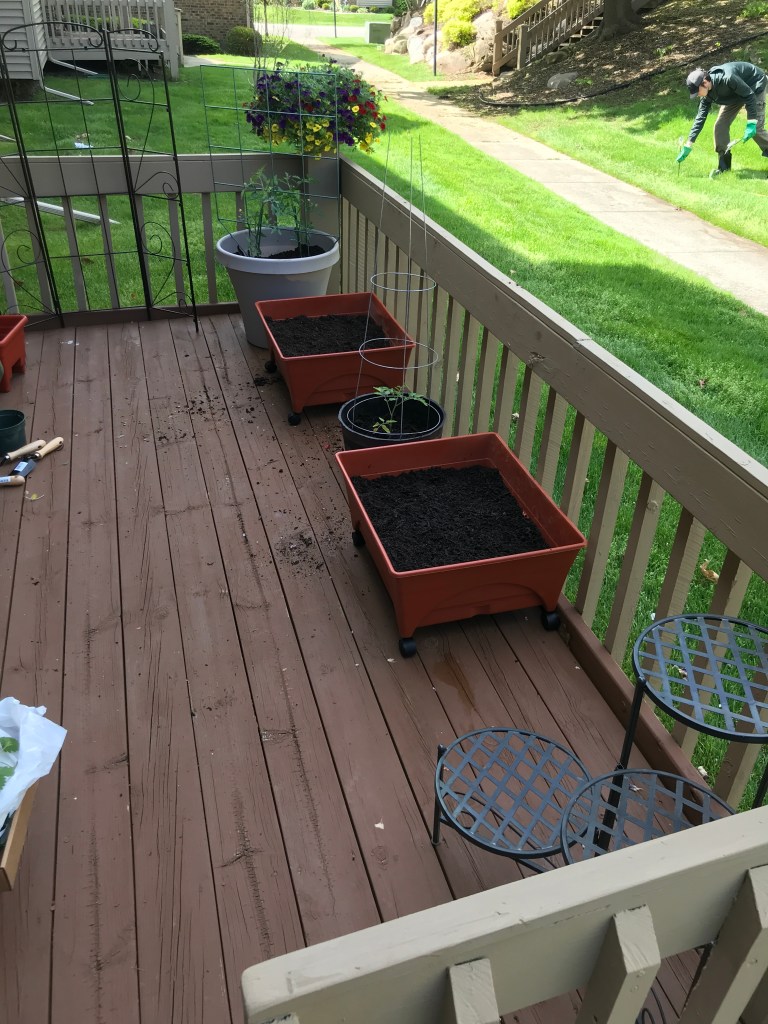
The “bare bones” where I started. Two planter boxes containing two types of peas, lettuce, beets, lavender and eggplant. Super sweet 100 tomatoes are in the closest pot and sungolds in the far pot. It expanded rapidly from here.

My enthusiasm for the project got the better of me at the beginning and I decided why not see what else we could add to this little experiment. My grandmother always loved morning glories and I remember the sunflowers that always grew along the length of the backyard fence, their bright yellow heads bobbing in the warm late summer/early fall breezes were always the grand finale of the season. I also thought fresh herbs would be an obvious addition as well and so added thyme, rosemary, tarragon, oregano, marjoram, basil, pineapple sage, chives and a fennel plant. Trust me….it didn’t end here.

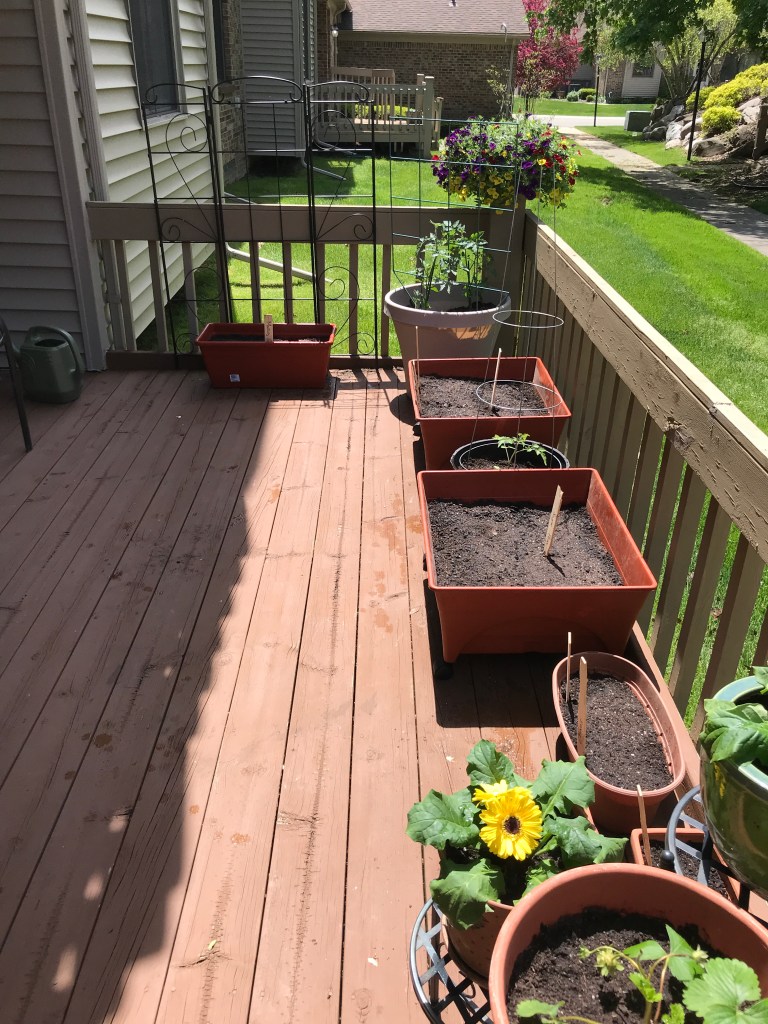
Some new additions joined my growing farm. A pair of gerbera daisies and a pot of pansies added some much needed color. The herbs were just planted as well as a lone strawberry plant in the foreground. I also planted a box of morning glories along a trellis in the background. At this point we’d already added two coneflowers we got from Megan’s mom and planted a bunch of sunflower seeds in some soil on the other side of the patio railing.

Early on I developed a desire to find a spot for little forlorn plants my mom and I found in different places. Though it might require some fuss I figured we could always find a space for some orphan that popped up. The strawberry plant was just such an orphan. It wasn’t long until our hard work began paying off and we noticed little sprouts popping up in various spots with, I’d say, the morning glories being first.

First out the gate! One of my grandmother’s favorite flowers morning glories, these sprouts popped up after about a week.

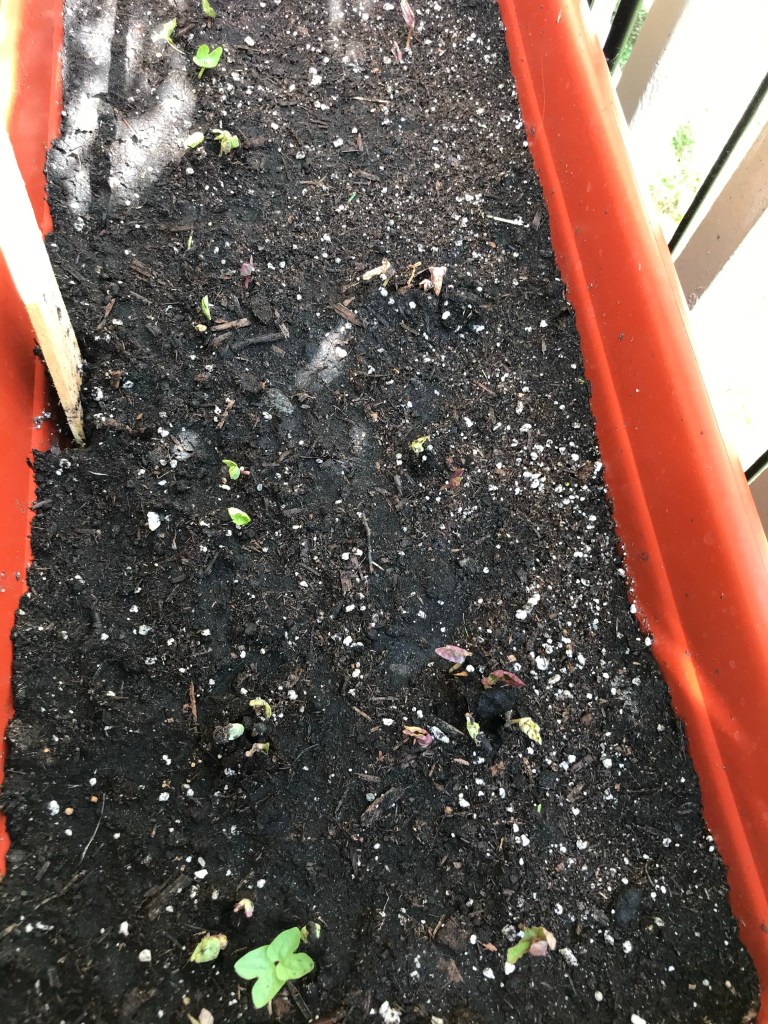
As May moved into the warmer weather of June gradually the garden became full of little sprouts. Soon, little micro greens of lettuce, beets, eggplant and peas were growing seemingly overnight and it was amazing to be growing not only living things but also food for us.

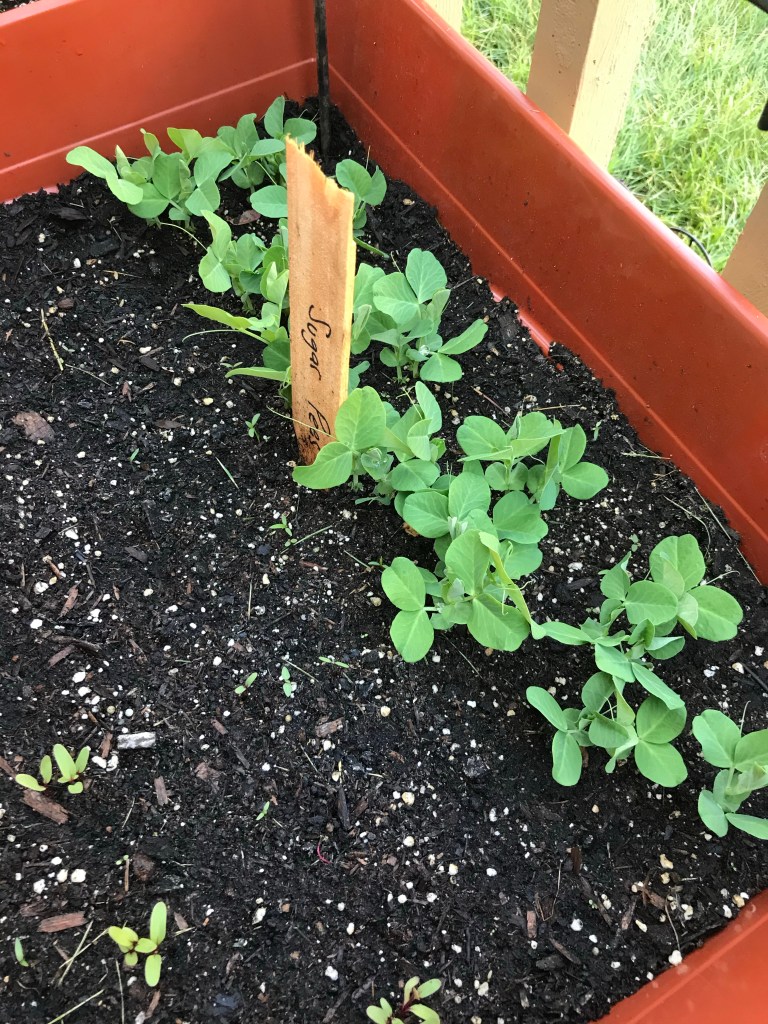
One variety of peas I planted, what I found was the soil was too moist because of my choice of planting vessel. Unfortunately, I would lose both types of peas and would have to replant.
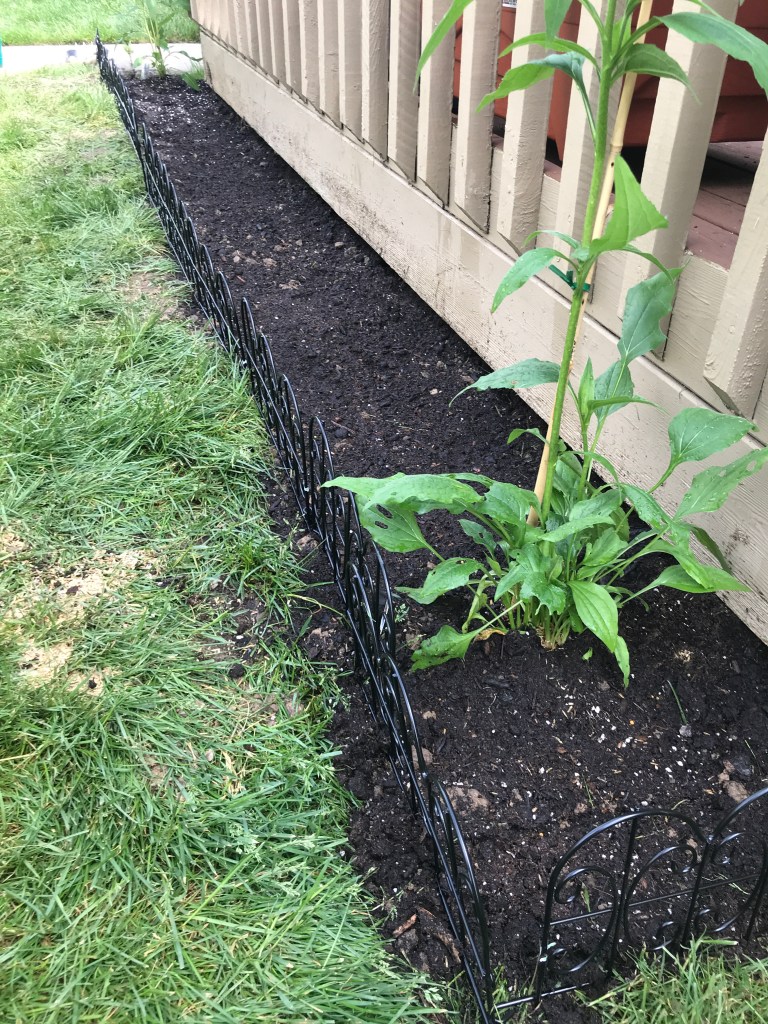
Megan’s mom gave us these two coneflowers to bookend the sunflowers. Come the end of summer they would increasingly dwarfed by them.
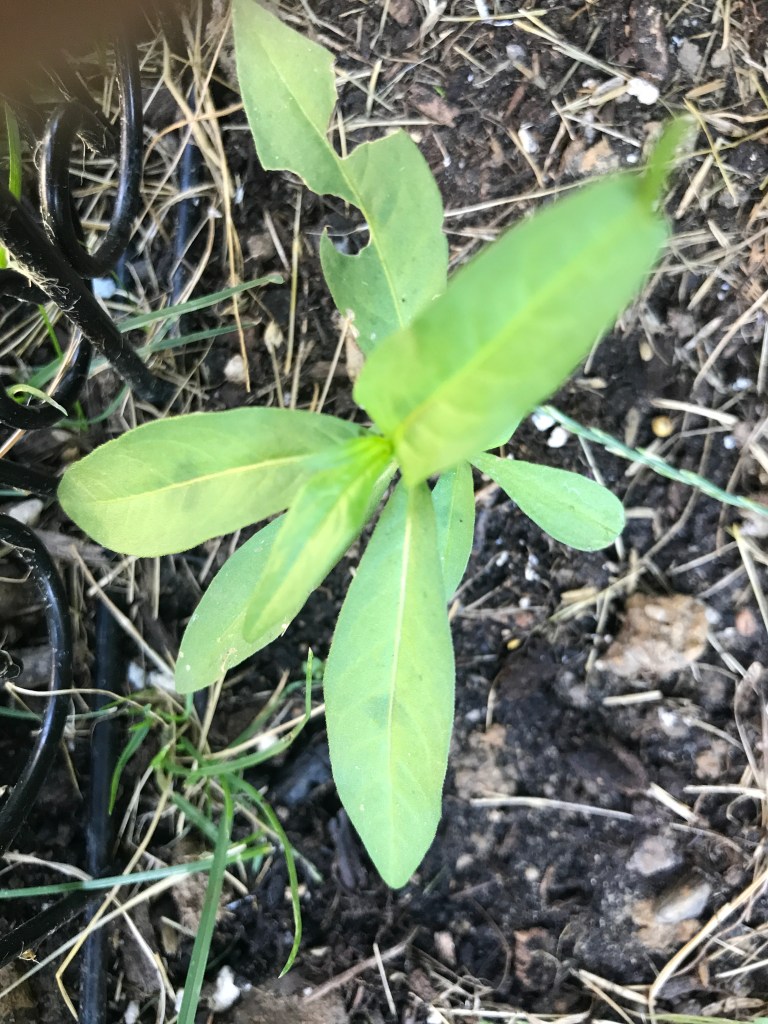
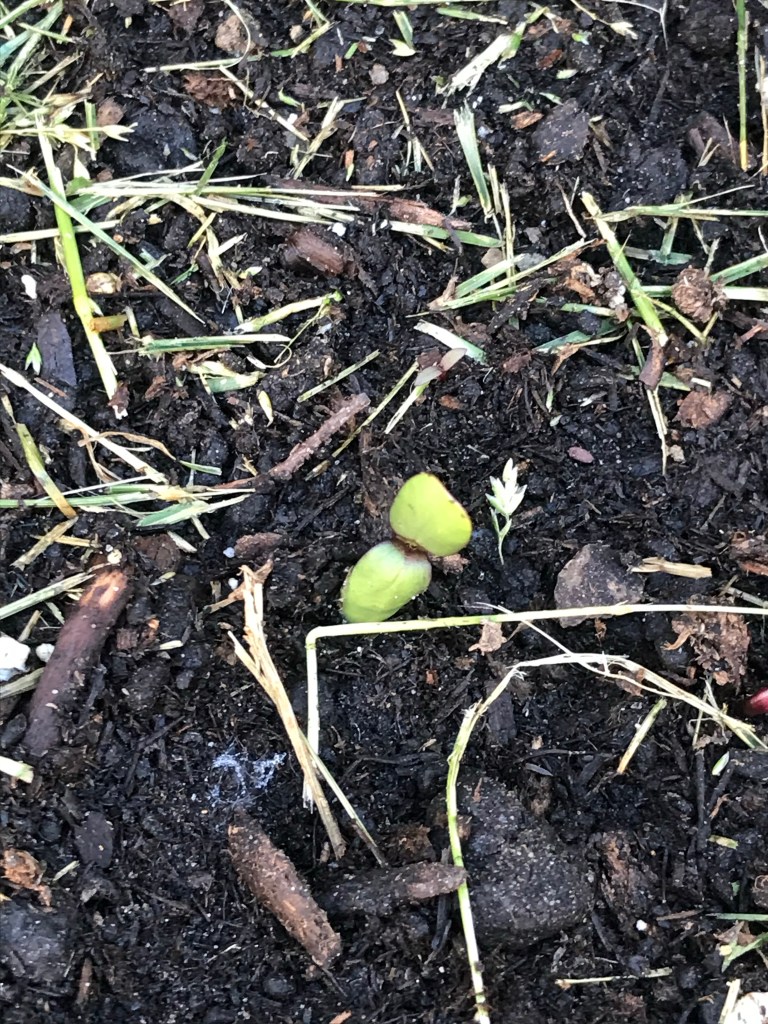
Speak of the devil, our first sunflower sprout. When you glimpse them at the end of summer it’s hard to believe they were once this small.

With plenty of warm sun and fresh water everything seemed to take off, ESPECIALLY the sunflowers. I honestly believe at one point they were growing a few inches a day. It is such a source of satisfaction when you see a living plant that you invested a little of your life and live, into. Next, part 2

Embracing your roots: in food and life

So many of us who choose cooking as a profession do so because it is strongly rooted in our personal lives. I’m not talking about those who cook for a paycheck, I’ve met plenty of those, I’m describing those who cook with great heart and soul and form a deep, abiding connection with their dishes. How many of us, this goes beyond international borders, think back to a dish we remember from our childhood and can almost taste it? Perhaps even more than tasting the dish there are memories associated with that dish, memories of people and events that maybe help us recapture, for however brief a time, a bit of the past.

A perfect example is the Christmas cookies my mom makes every year since taking the reins from my grandfather. From the spicy, chewy gingerbread to the classic peanut butter with a Hershey’s Kiss on top they carry so many positive memories for me. When I smell gingerbread baking for the first time, I’m taken back to the house my mom and I lived in with my grandparents. I remember sitting in the faintly lit living room, the only illumination being that coming from the dining room, while my uncle David…as in love with Christmas as I am, slipped Nat King Cole onto the record player. This would be days before the decorating of a Christmas tree or the wrapping of presents.

Another example is the German Potato Salad my grandfather would make, usually with Polish sausage and baked beans. I know it’s not classical German food and my grandfather was not a gourmet, but a good man doing what he could to feed a large family. I remember how I used to look forward to a big plate for dinner because I loved it and because he always made it on Fridays so I knew I had two days of fun coming up. I remember sharing dried pieces of bread with my grandmother from a huge cast iron pan, long before I had ever heard the word croustade. These dishes, however sometimes simple they may be, resonate with we who grow to sacrifice our nights, weekends, holidays and so forth cooking for others. They inspire in us a desire to help others find that connection with a meal that they remember fondly, whether it was at a crowded family table in cozily warm kitchen, or a dish shared by newlyweds on honeymoon in Paris, Rome, Budapest or a thousand other places. 🙂

The Underrated Root: The Carrot (a little culinary history)

In his book, The Third Plate, Chef Dan Barber uses the carrot to describe his vision for a revolution in not only what and how we eat, but how we cultivate it. Chef Barber sees the day when our diets move from being so heavily protein centric with the generic sides so many of us are used to, to more of a focus on ethically cultivated vegetables, fruits and grains accentuated by proteins. Case in point is his example of a carrot steak, accompanied by a sauce made from underutilized cuts of meat. So let’s take a look at this carrot shall we.

There is so much more to carrots than simply being a component in mire poix, a partner to peas in that veg mix a lot of us got as kids or the main ingredient in carrot cakes. Carrots as we know them today are actually the product of a great deal of selective breeding. Carrots or Daucus Carota, their scientific name, are native to Europe as well as regions of Iran and Afghanistan where their first harvesting took place and their native form, in fact, more resembled the parsnip to which they are closely related. Initially, carrots were not harvested for their roots but rather their seeds and aromatic greens, much like some their other close relations parsley, cilantro, fennel, dill and anise. Kind of ironic that it is now the root we so highly prize. It is believed that carrots, in their original form, were introduced to Europe by the Moors, during their conquest of Spain in the Middle Ages.

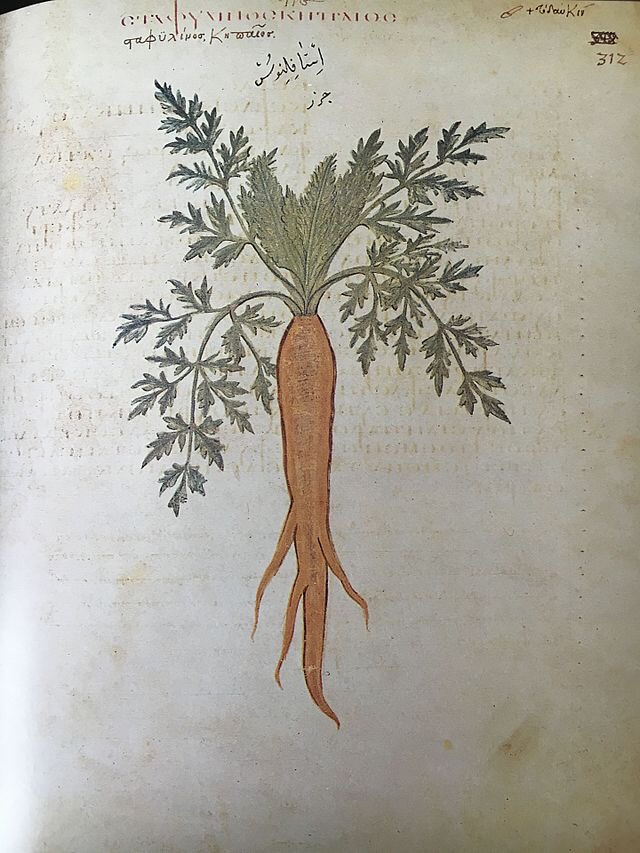
A depiction, labeled “garden carrot”, in a 6th century printing from Constantinople. Constantinople was the capital of the eastern half of the Roman Empire.

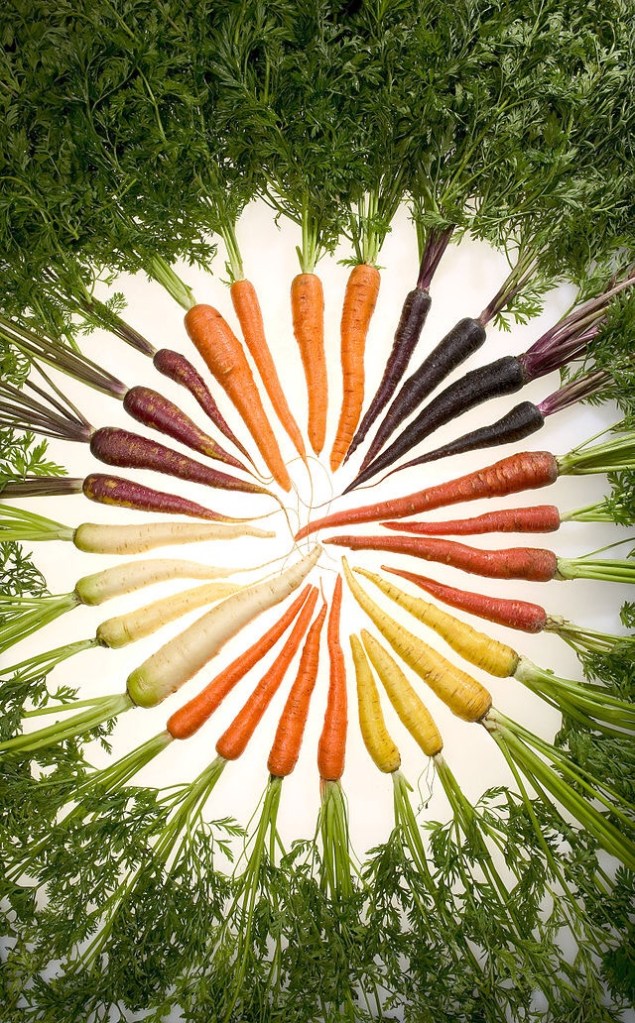
Over time, a desire to increase the sweetness, decrease the bitterness and reduce the woody nature of the core led to the slow, selective breeding of the carrot that has produced at least 175 different varieties to count. Along the way the very pale almost white color of the native carrot has spawned into a rainbow of hues such as purple, orange, black and red. There are countless sizes available as well, stemming from the large bulk carrots that often find their way into stews and deer feed, to the thin, tender heirloom carrots and the small thumb carrots.

Some of the colors made possible by selective breeding of Daucus Carota over the centuries.

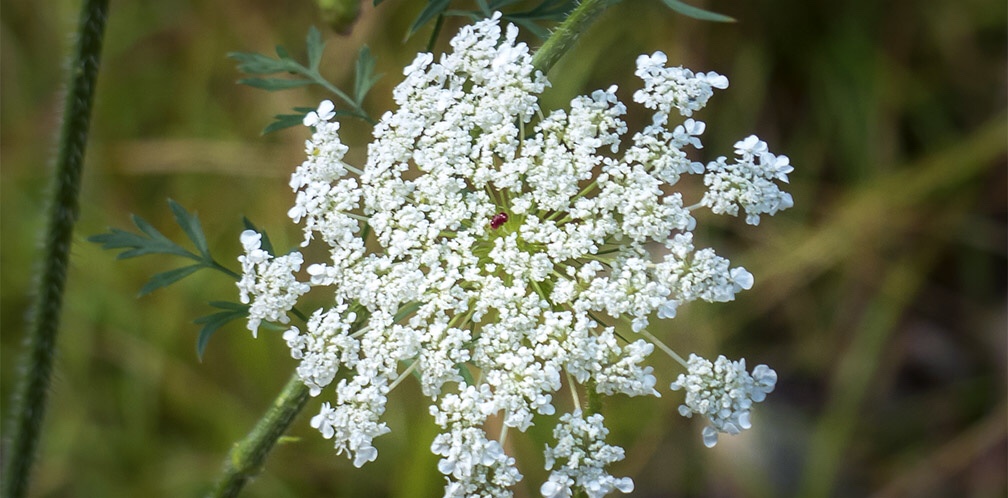
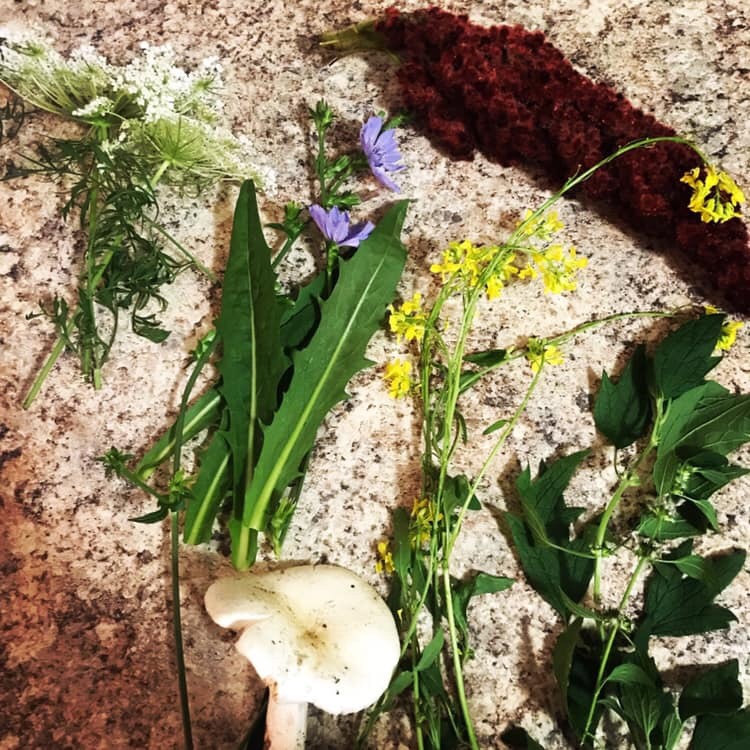
From a culinary aspect, carrots are both extremely versatile and nutritious. Their fibrous character and stored sweetness make them the perfect fit for puddings in England, chutneys in India, roasting to accompany lamb or goat in North Africa or shredding to bake into a cake in the American South. Carrots are also rich in both anthrocyanins, powerful anti-oxidants and alpha- and beta-carotenes, both rich sources of vitamin A. Unfortunately, the story we were always told about eating all our carrots for strong eyes is false. Carrots even sometimes find their way into wedding and Mother’s Day bouquets in the form of Queen Anne’s Lace which is the flowering stage of the carrot in its original, native form. Queen Anne’s Lace is actually one of the items I discovered my first day of foraging for wild, edible sources of food. When the plant flowers, however, it is then too far along in growth for the root to be palatable.

The haul from my first foraging excursion, note the Queen Anne’s Lace in the upper left hand corner.
Queen Anne’s Lace

I hope you’ve enjoyed this journey through the world of carrotdom. It’s part of my intention with this blog to find things I don’t know and learn them while sharing them with others. Being a cook, being a chef, is about always realizing you don’t know anywhere close to all there is to know about cooking. I feel there’s something inherently exciting and inspiring about that. Til next time, keep cooking!

Lifelong Project: Eating and Living Healthier

I will admit this isn’t the first time that I’ve been told by a doctor that I have to lose weight. Those other times I took the advice and told myself that I’d make changes with healthier eating and more exercise and yet, like so many others, I found myself giving in to so many of those unhealthy temptations. If you’ve gotten the same advice you know what I mean, a late night bag of chips, another slice of pizza or three, a huge, greasy spoon breakfast or pigging out on the holidays. In my younger years I worked out for hours a day and so I just ate whatever I wanted since I’d be burning all those calories off, however, as I get older it’s time to finally take my health seriously.

So I’ll be broadening the approach of this blog to include some dishes of a healthier nature that are still of an elevated and refined nature. I’ll also be including updates on the progression of my road to being more healthy and fit. This has been a short blog post but fear not, there is more to come. See you in a bit!

Scallops, the North African way

One need only look at the region known as North Africa to see why it has long been a melting pot for all manner of societies, cultures and religions and continues to be so to this day. Ancient trade routes wind back and forth through countries like Algeria, Morocco and Tunisia, which themselves are a stones throw or a day’s sail from the likes of Spain, France and Italy. Add to that the presence of groups such as the Bedouin and Berbers with their nomadic heritages and it’s one of the most culturally rich areas on Earth. One of the benefits of being such a melting pot is the vast array of flavor profiles, spices and preparations that each group contributes to the overall dynamic. One such example would be the blend of spices, in countless variations scattered across the map, known as Ras El Hanout.

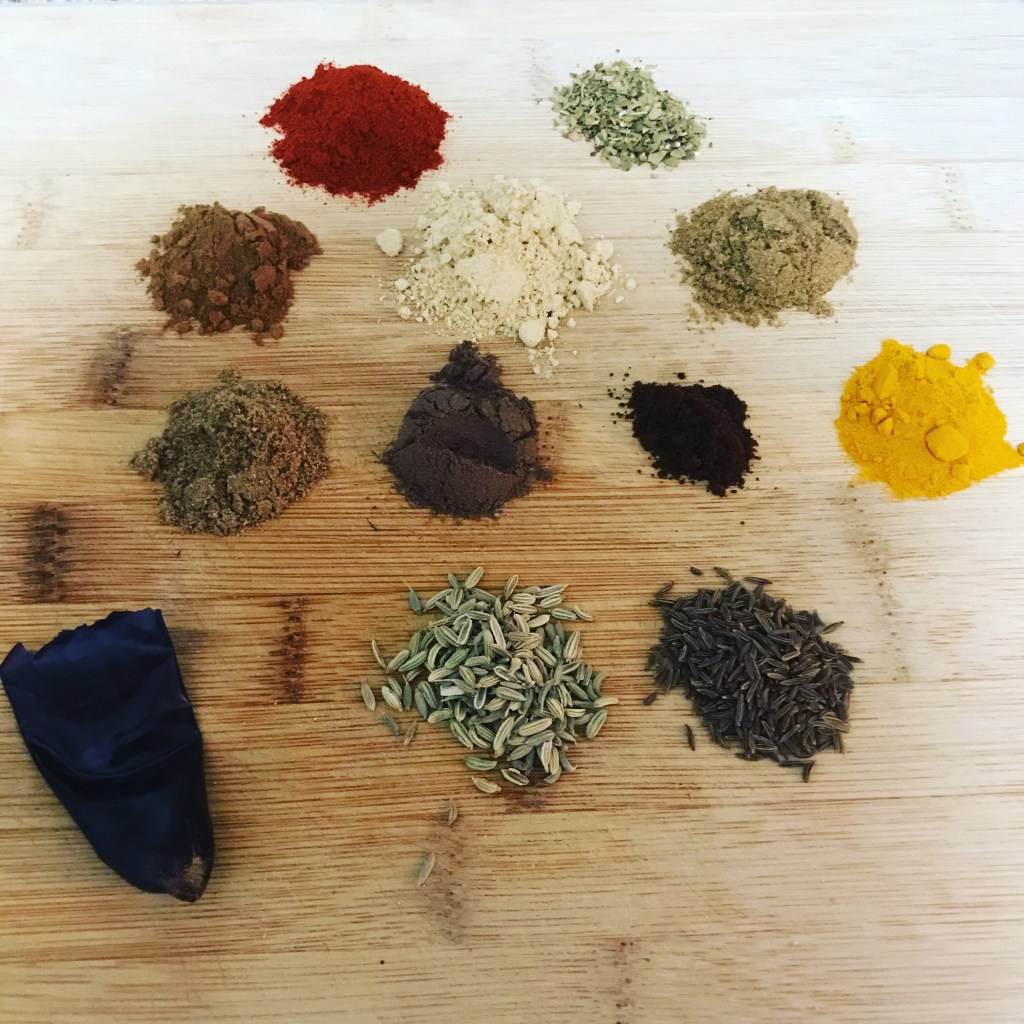
It’s almost impossible to find two families across North Africa who use the same spices, in the same amounts to produce their version of Ras El Hanout. Spices such as turmeric, cumin and saffron are common but others such as cinnamon, nutmeg and cloves can be found as well. One of the most common uses of Ras El Hanout is in the making or tagines, a common stew made from lamb, seafood, as well as vegetables and fruits. For my rendition of Ras El Hanout I chose the following selection of spices: cinnamon, nutmeg, cloves, turmeric, cumin, coriander, allspice, oregano, fennel, caraway, paprika and a touch of guajillo pepper.

Spices being measured for my version of Ras El Hanout.
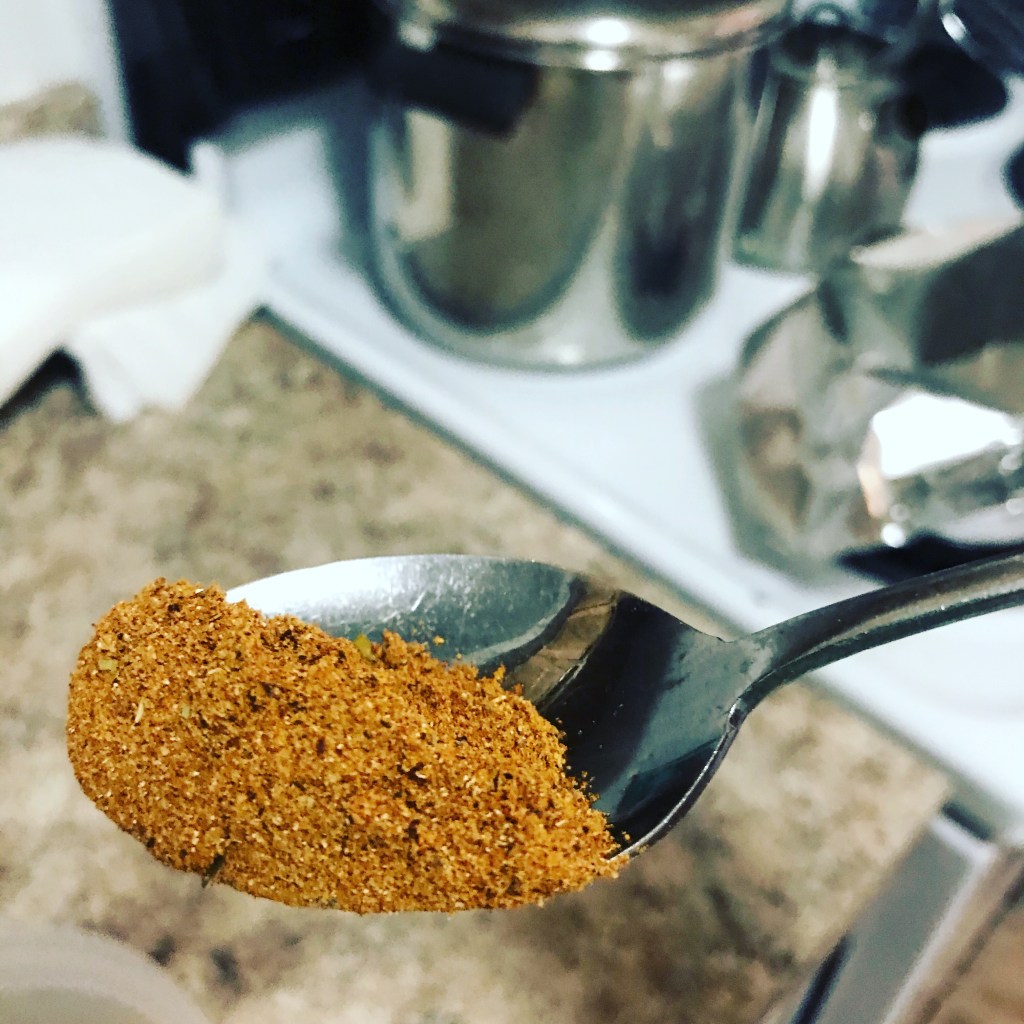
Finished product

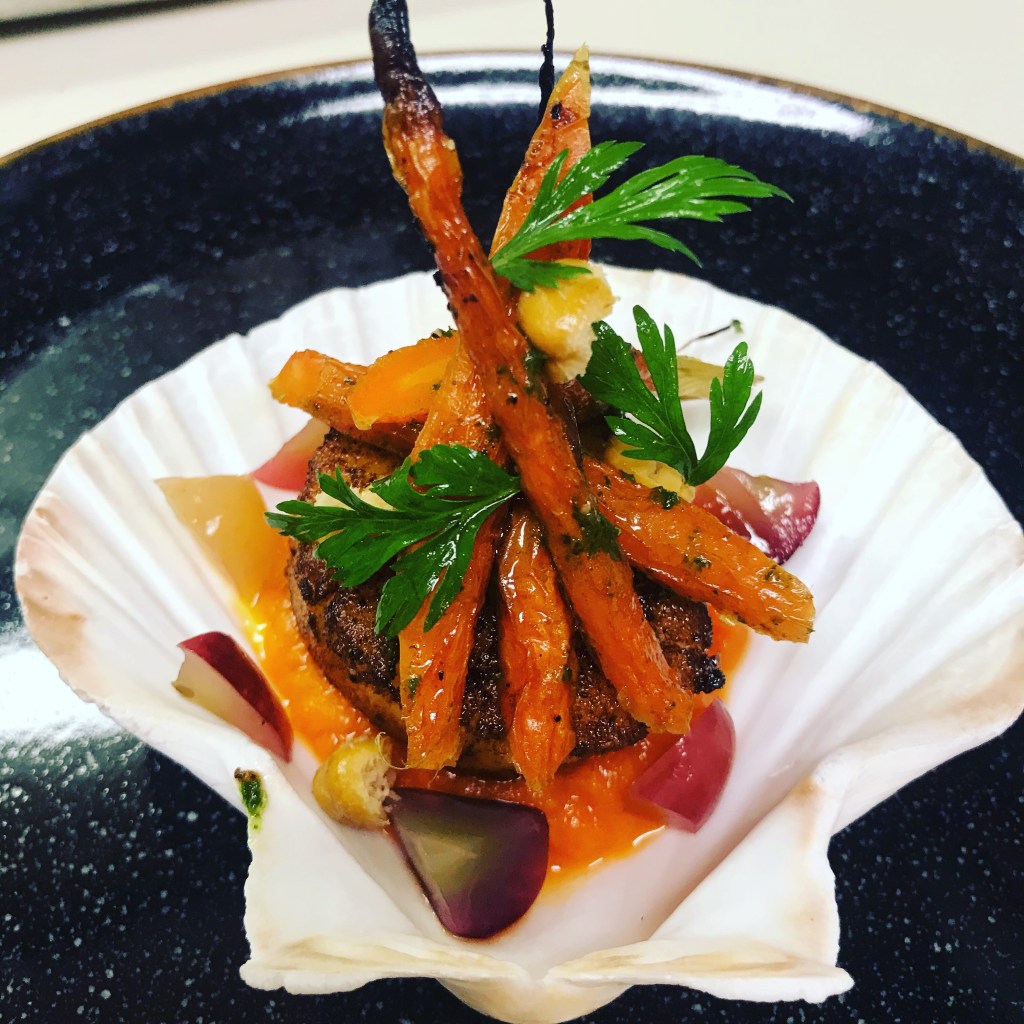
Instead of a tagine, I took some inspiration from a dish on the menu at the French Laundry which combines scallops, an asparagus purée, asparagus florets and tomato concasse. In place of the asparagus I used some wonderful, tender organic carrots. I began with a carrot puree, cooking the carrots simply in salted water until they were just tender. These I then puréed with some of the cooking liquid, pressed them through a sieve and cooked them down to intensify the flavor of the carrots. I then finished the purée with a light touch of honey, some of the brine from my pickled grapes, salt and cayenne.

Secondly, I roasted some of the smallest carrots in the oven with a generous flavoring of olive oil, salt, pepper, orange zest and grape brine. These were then finished with a “dressing” made from the deep green carrot tops. Lastly I did an oblique cut on some of my pickled grapes for a garnish with some crispy chick peas. Once all of my mise en place was complete I seared some scallops, well seasoned with Ras El Hanout, and my dish was ready for plating. So delicious!

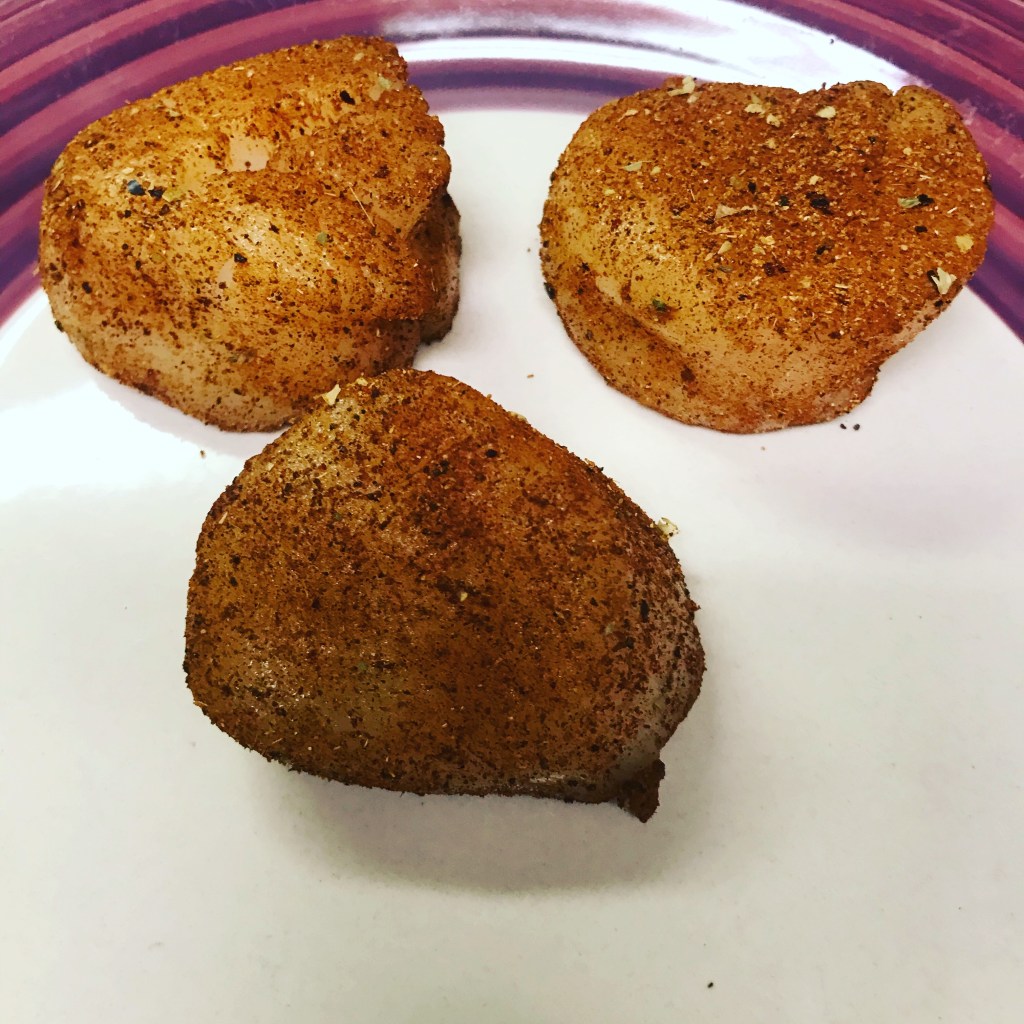
Ras El Hanout seasoned scallops, ready for searing.
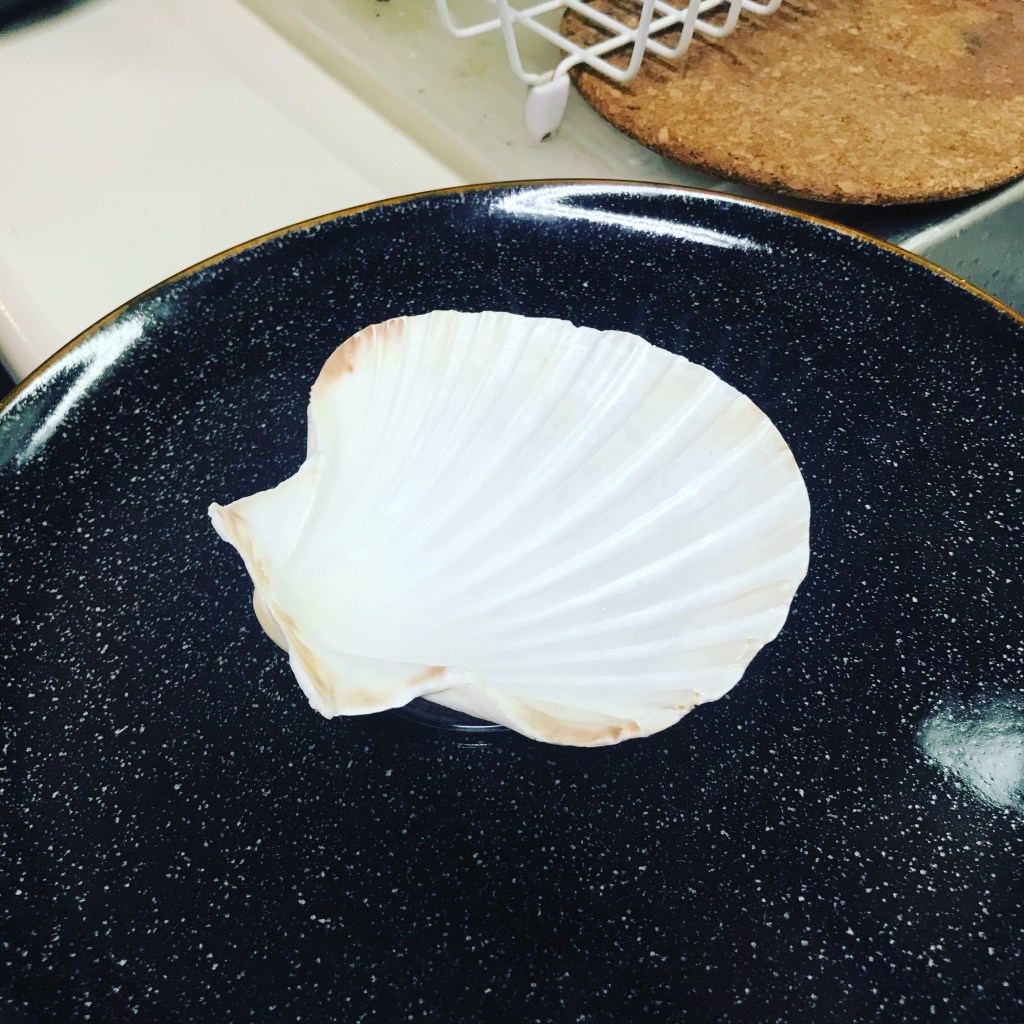
I found these cool natural shells on Amazon. I finally had something to use them for.
Finished dish! It came out better than I thought it would.

Macarons: I can finally eat them

For a pastry that is so iconically French, you might be surprised to know that macarons originated in Italy. While not entirely the macaron we are used to today, they were made by the private cooks of Catherine de Medici as early as 1533. When Catherine departed Venice to marry Henry II, future king of France, her cooks came with her. The macaron went through a few “alterations” to become what so many people go crazy for today. One long defining characteristic of macarons has been its use of almond flour. Almonds were easily accessible when macarons were created, from a flavor perspective they are neutral in flavor and their flour won’t form gluten and so the macaron is able to retain its light texture. The downside of the insistence on almond flour is that those of us with nut allergies can’t eat them. I have found a way around that.

Going through culinary school included two sections of pastry instruction, both of which included macarons for some but not all of us. I wasn’t lucky enough to get to learn them so I had to go the trial and error route on my own at home. I have to say, macarons turned out to be as challenging to master as I’ve heard. Every time I baked a batch I wondered what do they actually taste like, but couldn’t snack on one. I finally made my mind up to find a solution and after much looking came across using pumpkinseeds. Once pulsed in a spice grinder and then sieved, pumpkin seed flour has the exact same texture as almond flour. From there it’s merely a matter of whether you use the French meringue or the Italian meringue approach to creating your macaron paste. With a French meringue the granulated sugar is dusted into the aerating egg whites while using an Italian meringue involves creating a simple syrup, boiling it to about 240°, then streaming that into your egg whites. The recipe I currently use involves a French meringue. I think you’ll agree that nut free macarons can be a great success.

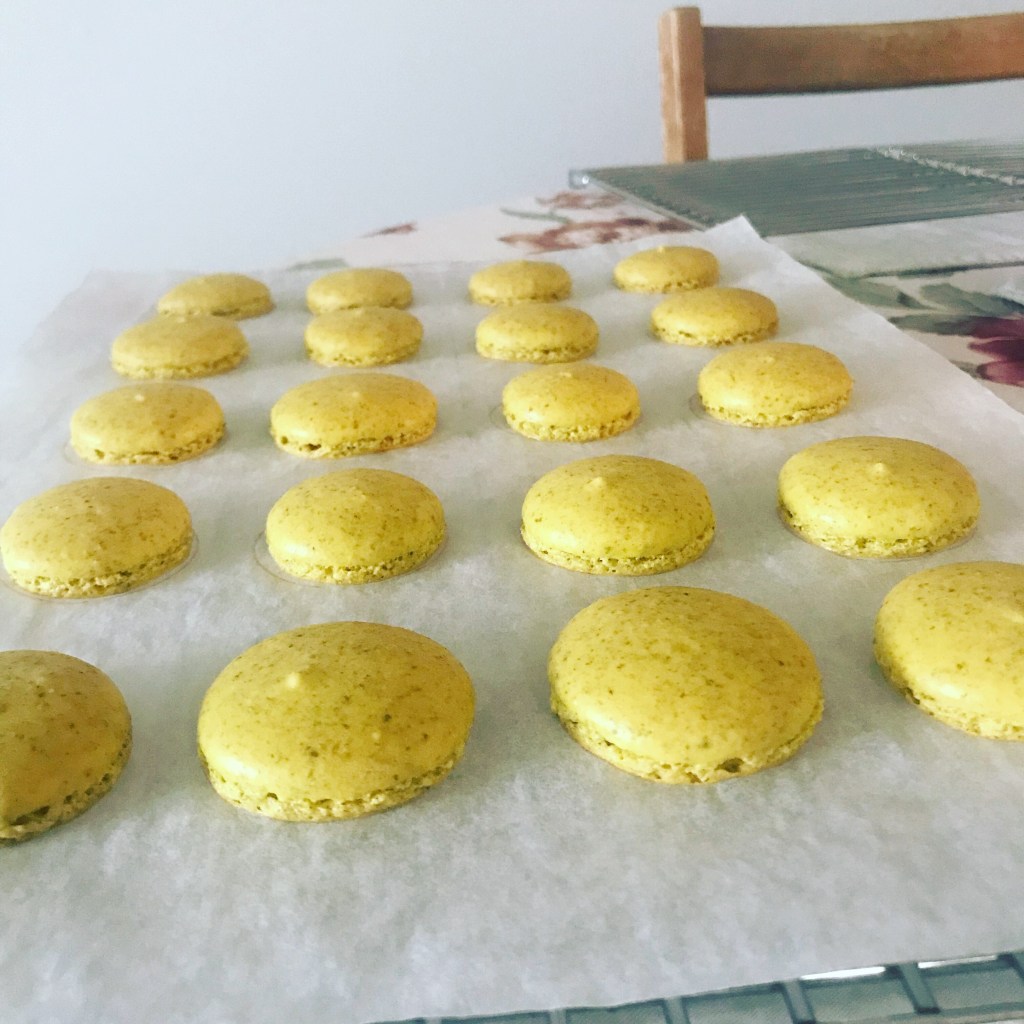
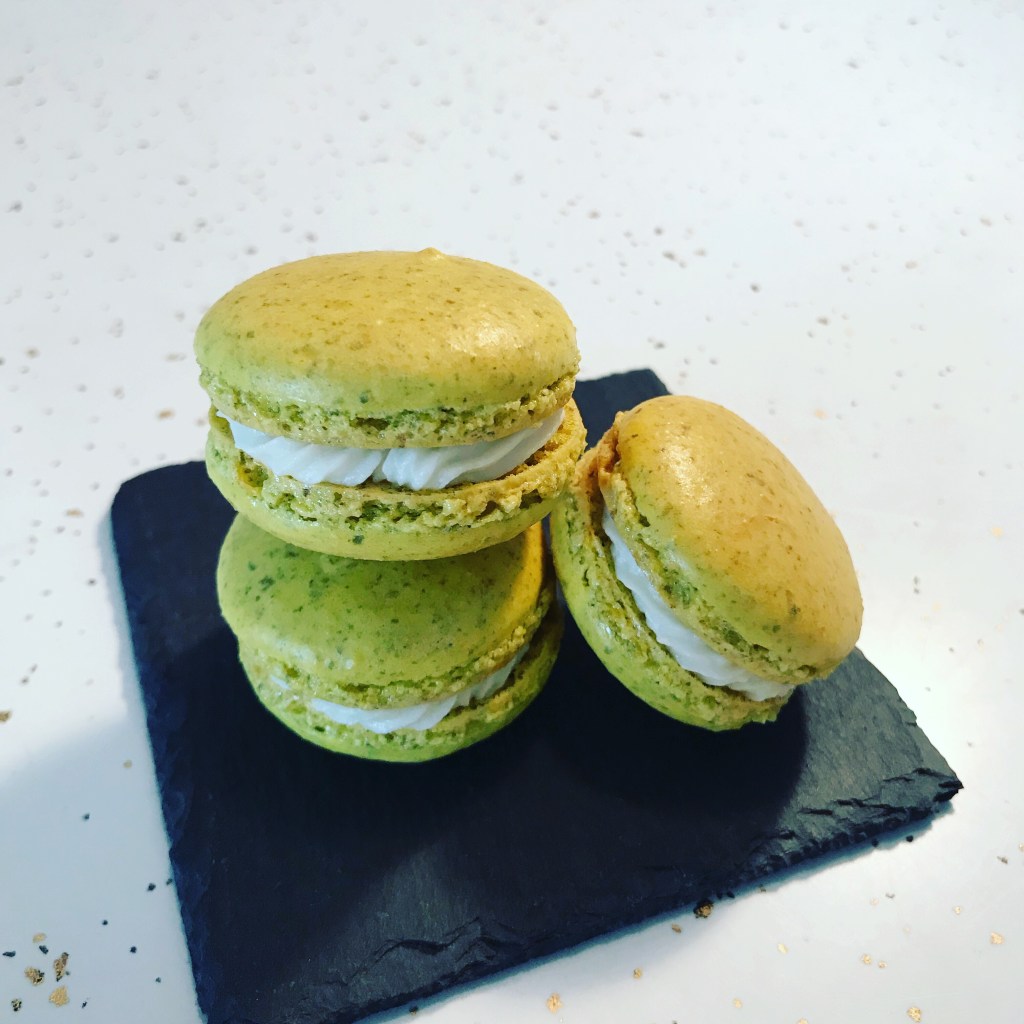
First batch of nut-free macarons, lemon-clove. These got a lemon curd filling with a simple buttercream frosting.
Second batch: fall spice macaron, pumpkin curd, bourbon-cream cheese frosting.

Developing consistency at macarons has been a challenging, sometimes frustrating process but it’s a good mirror for life as a culinarian. Nothing worthwhile comes easy! Until next time guys!

Project: Quick Pickles( a study)

From some of my earliest memories I have loved pickles. As a kid I remember how delicious my grandmother’s garden raised cucumbers and beets were after spending time in a garlicky, salty, sour brine and would quite often come close to eating a whole jar on my own. Pickles are found in most cultures around the world since it’s a time honored method of preserving vegetables, fruits and other items for extended use while also giving them an aroma and flavor profile that make them great accompaniments to cured and roasted meats and fish. The pickling process can also add nutrients such as vitamin B, which is introduced by the bacteria active in the fermentation process.

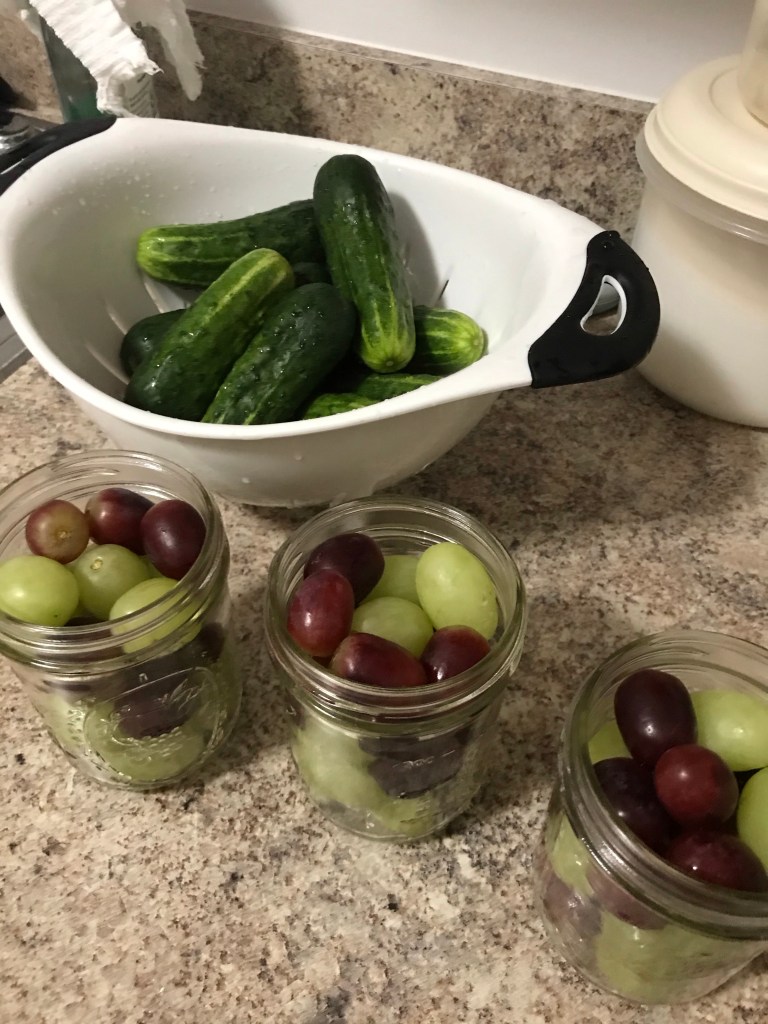
The New York Food Museum’s Pickle History Section presents archaeological evidence of cucumbers native to India being pickled and transported to the Tigris Valley of Iraq in 2030 BCE. Many foods were pickled for consumption on long voyages before the days of refrigeration, these include not only vegetables but fish, pork and nuts. For my pickling project today I chose some beautiful cucumbers and a mix of red and green seedless grapes.

Cucumbers and grapes ready for some aromatics and brine!

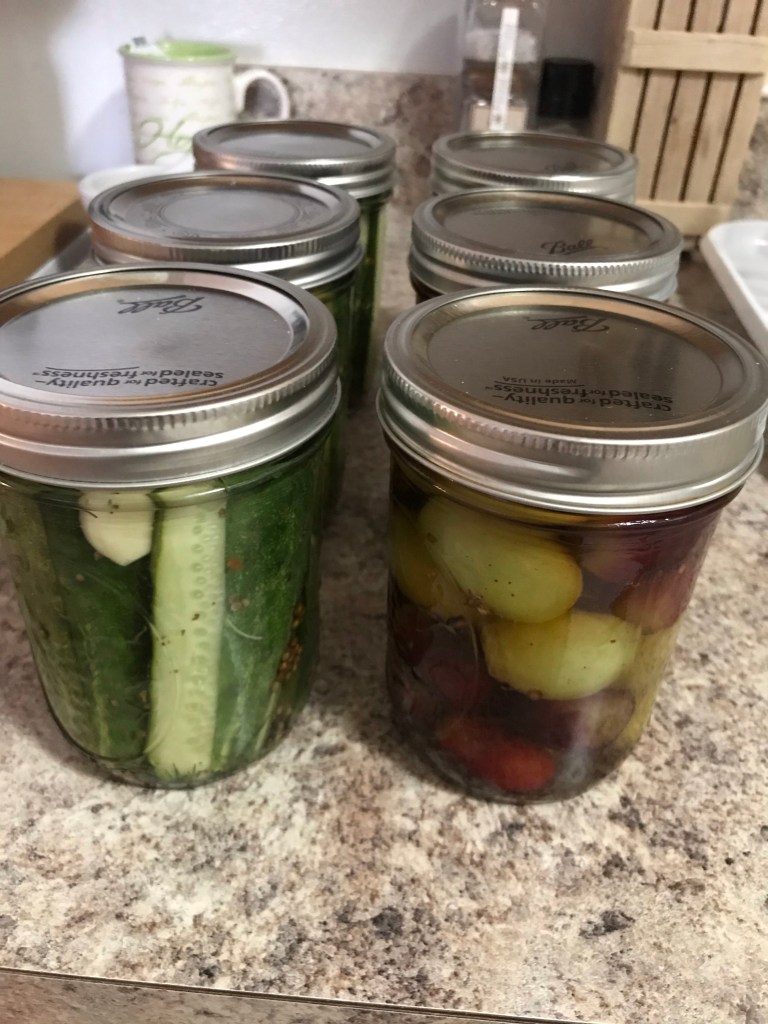
I used a mix of white and rice vinegars for the cucumbers and apple cider and rice vinegars for the grapes. In terms of aromatics the grapes got allspice, cloves, cinnamon and a little coriander. I chose fresh dill, coriander, mustard seed, celery seed and fresh garlic for the cucumbers. After jarring up both items I followed a 3-2-1 ratio for the brine which gave me 3 parts vinegar, 1.5 parts water and using salt/sugar to taste as well as to adjust the acidity. Vinegars are the product of a double fermentation in that the sugars in grapes are fermented to produce the alcoholic beverage wine, wine is then passed through a second ferment which involves inoculating vats of younger wine with acetobacter bacteria to produce ascetic acid. Once the brine is boiling it’s time to pour into my jars!

Jars of grapes and cucumbers in their coinciding brines, ready to develop flavor.

As the grapes and cucumbers sit in their brines for a few days the fermentation involves the water leaving the food items, which dilutes the brine. The acidity is then drawn into whatever’s being pickled and this lowers its pH, which makes it increasingly hostile to harmful bacteria. Now it’s a matter of waiting and giving them time to build flavor. Can’t wait!